
Cuvillier Verlag GmbH



| Departments | |
|---|---|
| Book Series (99) |
1415
|
| Nachhaltigkeit |
3
|
| Gesundheitswesen |
3
|
| Humanities |
2415
|
| Natural Sciences |
5432
|
| Engineering |
1822
|
| Engineering | 292 |
| Mechanical and process engineering | 873 |
| Electrical engineering | 700 |
| Mining and metallurgy | 30 |
| Architecture and civil engineering | 76 |
| Common |
97
|
|
Leitlinien Unfallchirurgie
5. Auflage bestellen |
|
Advanced Search
CMOS-integrierte Feldemissionsspitzen (English shop)
Thomas Maul (Author)Preview
Table of Contents, Datei (32 KB)
Extract, Datei (100 KB)
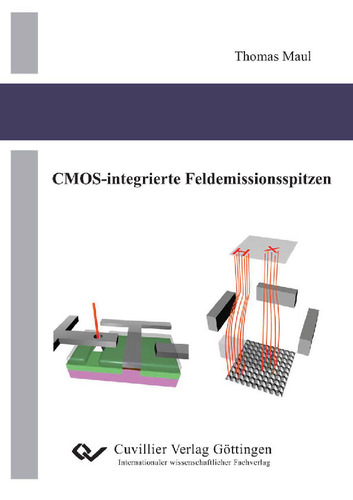
This work addresses the stabilisation of field emission currents with a view to evaluating them for future applications. Its focus is the integration of silicon tips into field-effect transistors in order to minimise the technology- and environment-related fluctuations to which the current emitted from tips is subject.
Alongside detailed theoretical foundations on the topic of field emission and a documentation of the state of the art, process and electrical simulations prepare the ground for the practical implementation. Comparing free-standing and ring extractors, and for tip radii of curvature of 10 and 20 nanometres that are feasible in practice, the simulation results show possible electric field enhancement factors of more than 10.
To evaluate the concept, the emission properties of field emitters fabricated from silicon by various wet- and dry-chemical etching techniques are investigated. Emitters deposited by an electron beam (EBID) are also employed. To regulate the emission currents, both an external connection of high-quality MOSFETs with field emitters and their monolithic integration in a single device are examined.
It emerges that, at emission currents of a few nanoamperes under vacuum conditions of 5 · 10−7 mbar, fluctuations of the same order of magnitude can be observed. With a MOSFET connected in series, the fluctuation behaviour is significantly reduced. The emission level can thereby be set independently of the extractor via the gate potential of the transistor.
Measurements over several minutes reveal a finely tunable regulation of the emission current between approx. 100 picoamperes and currents of approx. 10 nanoamperes predetermined by the emitters. Particular attention was paid to the issue of potential leakage currents, which can distort the interpretation.
The lifetime of the arrangements proves problematic. The experiments confirm earlier publications that seek to elucidate the failure mechanisms. Achievable lifetimes of emitter–extractor arrangements in this work range from a few seconds to several minutes.
| ISBN-13 (Printausgabe) | 3869551763 |
| ISBN-13 (Hard Copy) | 9783869551760 |
| ISBN-13 (eBook) | 9783736931763 |
| Final Book Format | A5 |
| Language | German |
| Page Number | 166 |
| Edition | 1 Aufl. |
| Volume | 0 |
| Publication Place | Göttingen |
| Place of Dissertation | TU München |
| Publication Date | 2009-12-23 |
| General Categorization | Dissertation |
| Departments |
Electrical engineering
|


