
Cuvillier Verlag GmbH



| Departments | |
|---|---|
| Book Series (99) |
1415
|
| Nachhaltigkeit |
3
|
| Gesundheitswesen |
3
|
| Humanities |
2412
|
| Natural Sciences |
5430
|
| Mathematics | 230 |
| Informatics | 320 |
| Physics | 982 |
| Chemistry | 1371 |
| Geosciences | 131 |
| Human medicine | 246 |
| Stomatology | 10 |
| Veterinary medicine | 112 |
| Pharmacy | 147 |
| Biology | 837 |
| Biochemistry, molecular biology, gene technology | 121 |
| Biophysics | 25 |
| Domestic and nutritional science | 45 |
| Agricultural science | 1006 |
| Forest science | 201 |
| Horticultural science | 20 |
| Environmental research, ecology and landscape conservation | 149 |
| Engineering |
1821
|
| Common |
97
|
|
Leitlinien Unfallchirurgie
5. Auflage bestellen |
|
Advanced Search
Bauteil-Störfestigkeitsprüfverfahren für Kfz-Bussysteme (English shop)
Stefan Buntz (Author)Preview
Table of Contents, Datei (31 KB)
Extract, Datei (150 KB)
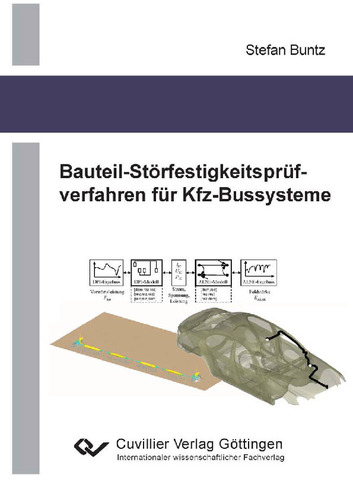
This dissertation addresses the correlation of various immunity test methods as currently applied in the automotive industry. Two methods in particular are analysed in detail and a relationship between their evaluation quantities is derived: the radiated immunity test method using an antenna (ALSE method) and the conducted immunity test method (DPI method).
Whereas the DPI method makes it possible to evaluate the immunity of individual components even before complex systems are available, radiated immunity testing is mostly used on finished subsystems or for the evaluation of the complete vehicle. However, in order to be able to ensure immunity validation early in the development process, it is necessary to trace the practically proven and verified limit values of the ALSE method back to corresponding limit values for the DPI method.
By means of simulations and measurements, this work establishes a correlation between the evaluation quantity of the radiated test method – the applied field strength – and the evaluation quantity of the conducted test method – the injected disturbance power. To this end, the radiated immunity test method is analysed and modelled in detail within a standardised test setup, as specified for example in ISO 11452-2. Using this simulation model, the disturbance current at the pin of the device can now be related to the evaluation quantity of the radiated method – the applied field strength. Likewise, with the aid of a simulation model of the DPI method, the disturbance current at the pin of the device can also be related to the corresponding evaluation quantity.
By means of this relationship between the evaluation quantities, it is possible to derive limit values for conducted immunity testing from the radiated test method, for which reliable and practically proven limit values are available.
About the author
After studying electrical engineering at the University of Ulm (2003), Stefan Buntz initially worked at EADS AG on the simulation of antenna structures.
From 2004 to 2008 he completed his doctorate in cooperation with Daimler AG at the University of Ulm at the Institute of Microwave Techniques in the field of automotive EMC measurement technology. Since 2009 Stefan Buntz has been working at Daimler AG on, among other things, the EMC and signal integrity of high-bit-rate data bus systems in motor vehicles.
| ISBN-13 (Printausgabe) | 386955164X |
| ISBN-13 (Hard Copy) | 9783869551647 |
| ISBN-13 (eBook) | 9783736931640 |
| Final Book Format | A5 |
| Language | German |
| Page Number | 152 |
| Edition | 1 Aufl. |
| Volume | 0 |
| Publication Place | Göttingen |
| Place of Dissertation | Universität Ulm |
| Publication Date | 2009-12-03 |
| General Categorization | Dissertation |
| Departments |
Informatics
Electrical engineering |


