
Cuvillier Verlag GmbH



| Departments | |
|---|---|
| Book Series (99) |
1415
|
| Nachhaltigkeit |
3
|
| Gesundheitswesen |
3
|
| Humanities |
2411
|
| Natural Sciences |
5429
|
| Mathematics | 230 |
| Informatics | 320 |
| Physics | 982 |
| Chemistry | 1371 |
| Geosciences | 131 |
| Human medicine | 246 |
| Stomatology | 10 |
| Veterinary medicine | 112 |
| Pharmacy | 147 |
| Biology | 837 |
| Biochemistry, molecular biology, gene technology | 121 |
| Biophysics | 25 |
| Domestic and nutritional science | 45 |
| Agricultural science | 1005 |
| Forest science | 201 |
| Horticultural science | 20 |
| Environmental research, ecology and landscape conservation | 148 |
| Engineering |
1821
|
| Common |
97
|
|
Leitlinien Unfallchirurgie
5. Auflage bestellen |
|
Advanced Search
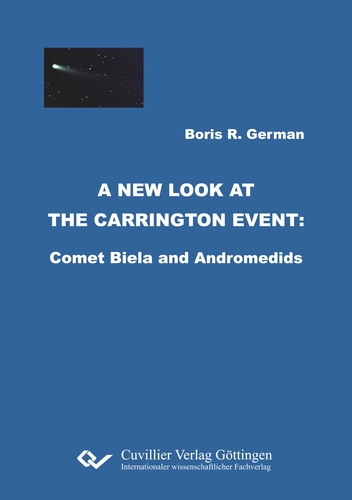
A New Look at the Carrington Event: Comet Biela and Andromedids (English shop)
Boris German (Author) ORCID ISNIPreview
Extract, PDF (11 MB)
Table of Contents, PDF (67 KB)
The Carrington Event of 1859 was the most powerful recorded geomagnetic storm, producing intense auroras at low latitudes and damaging telegraph systems worldwide. It is generally attributed to solar flares and coronal mass ejections, including a major white-light flare observed by Richard Carrington. However, the text proposes an alternative or additional explanation involving debris from Comet 3D/Biela and the Andromedids meteor stream. After the comet fragmented in the 1840s, its secondary comets and meteoroids may have interacted with Earth in 1859, potentially contributing to geomagnetic disturbances through magnetized particles entering the atmosphere. Over time, the Andromedids stream weakened as the comet’s remnants dispersed. The author argues that a purely solar explanation of the Carrington Event may be incomplete and that cometary material could also have played a role.
| ISBN-13 (eBook) | 9783689524555 |
| DOI | 10.61061/ISBN_9783689524555 |
| Final Book Format | A5 |
| Language | English |
| Page Number | 97 |
| Edition | 1. |
| Publication Place | Göttingen |
| Publication Date | 2026-01-30 |
| General Categorization | Non-Fiction |
| Departments |
Astrophysics and astronomy
|
| Keywords | Carrington Event, 3D/Biela Comet, Andromedids, SID, SIR, Dst, CIR, low-latitude auroras, geomagnetic disturbances, solar white-light flares, ICME, SEPs, MGD, Mazapil meteorite, cosmogenic nuclides, pinch effect, ambipolarity, FAC, Bh-deviation, GIC, IEF, event, storm, space, earth |


