
Cuvillier Verlag GmbH



| Departments | |
|---|---|
| Book Series (99) |
1415
|
| Nachhaltigkeit |
3
|
| Gesundheitswesen |
3
|
| Humanities |
2412
|
| Medienwissenschaften | 17 |
| Theology | 57 |
| Philosophy | 103 |
| Law | 430 |
| Economics | 863 |
| Social sciences | 423 |
| Sports science | 48 |
| Psychology | 233 |
| Educational science | 190 |
| History | 194 |
| Art | 111 |
| Cultural studies | 168 |
| Literary studies | 119 |
| Linguistics | 91 |
| Natural Sciences |
5430
|
| Engineering |
1821
|
| Common |
97
|
|
Leitlinien Unfallchirurgie
5. Auflage bestellen |
|
Advanced Search
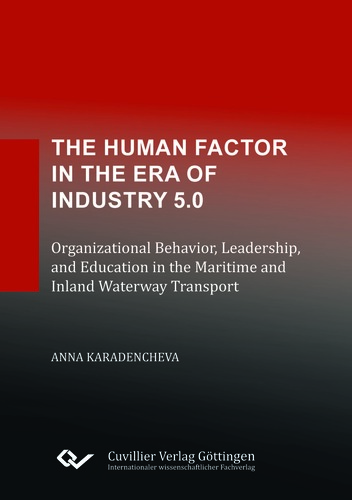
The Human Factor in the Era of Industry 5.0 (English shop)
Organizational Behavior, Leadership, and Education in the Maritime and Inland Waterway Transport
Anna Karadencheva (Author) ORCIDPreview
Extract, PDF (1.9 MB)
Table of Contents, PDF (160 KB)
This monograph explores organizational behavior as a dynamic relationship between individuals and organizations, emphasizing how professional identity and competence evolve in the context of Industry 5.0. In this new era, organizational behavior becomes a continuous adaptation process shaped by technological advancement, multicultural teamwork, and new forms of interdependence.
Focusing on the waterborne transport sector, the study highlights the particular importance of the human factor in an environment characterized by high technological intensity, operational responsibility, global mobility, and cultural diversity. It argues that efficiency, safety, sustainability, and social cohesion depend not only on digitalization and automation but also on leadership, emotional intelligence, intercultural competence, and organizational learning.
The monograph develops the Hybrid Human Factor Model for Industry 5.0, integrating four interconnected levels: individual, team, organizational, and educational. Based on theoretical analysis and quantitative empirical research, the model demonstrates that sustainable transformation in the maritime sector requires systematic development of human capital.
Structured across five chapters, the work combines theoretical foundations, methodological justification, empirical findings, and practical applications, including Executive Education and training programs designed to prepare future maritime leaders. Overall, the study positions the human factor as a strategic resource and key driver of sustainable development in the era of Industry 5.0.
| ISBN-13 (eBook) | 9783689524630 |
| DOI | 10.61061/ISBN_9783689524630 |
| Final Book Format | A5 |
| Language | English |
| Page Number | 238 |
| Lamination of Cover | glossy |
| Edition | 1. |
| Publication Place | Göttingen |
| Publication Date | 2026-02-10 |
| General Categorization | Habilitation |
| Departments |
Economics
Management |
| Keywords | Organizational Behavior; Industry 5.0; Human Factor; Waterborne Transport Sector; Maritime Leadership; Hybrid Human Factor Model; Individual Competencies; Team Dynamics; Organizational Culture; Executive Education; Sustainable Development; Human-Centric Innovation; Intercultural Communication; Emotional Intelligence; Organizational Learning; Digital Transformation; Human Capital Development, leadership, maritime, educational, communication, development, education, human |


