
Cuvillier Verlag GmbH



| Departments | |
|---|---|
| Book Series (99) |
1415
|
| Nachhaltigkeit |
3
|
| Gesundheitswesen |
3
|
| Humanities |
2411
|
| Natural Sciences |
5429
|
| Mathematics | 230 |
| Informatics | 320 |
| Physics | 982 |
| Chemistry | 1371 |
| Geosciences | 131 |
| Human medicine | 246 |
| Stomatology | 10 |
| Veterinary medicine | 112 |
| Pharmacy | 147 |
| Biology | 837 |
| Biochemistry, molecular biology, gene technology | 121 |
| Biophysics | 25 |
| Domestic and nutritional science | 45 |
| Agricultural science | 1005 |
| Forest science | 201 |
| Horticultural science | 20 |
| Environmental research, ecology and landscape conservation | 148 |
| Engineering |
1821
|
| Common |
97
|
|
Leitlinien Unfallchirurgie
5. Auflage bestellen |
|
Advanced Search
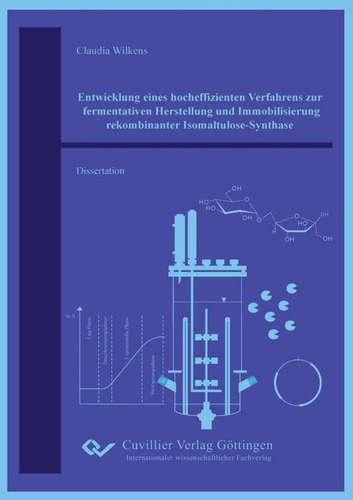
Entwicklung eines hocheffizienten Verfahrens zur fermentativen Herstellung und Immobilisierung rekombinanter Isomaltulose-Synthase (English shop)
Claudia Wilkens (Author)Preview
Table of Contents, Datei (53 KB)
Extract, Datei (73 KB)
Consumers’ sugar consumption behaviour has changed markedly as a result of the new nutritional trends of functional and wellness food. Demand for sugar substitutes has risen extremely in recent years. Isomaltulose, an isomer of sucrose, is a tooth-friendly sugar with a low glycaemic index, from which the reduced-calorie sugar alcohol PalatinitTM is produced on an industrial scale. In addition, isomaltulose can be used as a renewable feedstock for the chemical industry. Isomaltulose is obtained from sucrose by enzymatic conversion. The enzyme responsible for the isomerisation is isomaltulose synthase (PalI enzyme). The aim of this work was the optimisation of the bioprocess for the production of isomaltulose using recombinant isomaltulose synthase, from fermentative enzyme production through to an industrially applicable immobilised enzyme preparation. To optimise heterologous enzyme formation, a robust expression strain suitable for the industrial process was selected and the cultivation was subsequently scaled up from shake flask to 10 L fermentation scale. Since conventional process control did not lead to sufficient enzyme expression, a new, successful two-phase fermentation procedure was developed which, by controlling the oxygen supply to the cells, enabled high biomass formation and heterologous enzyme production. Using this two-phase fermentation strategy, 12 g/L biomass dry weight and 1.6 g/L highly active isomaltulose synthase were produced. To stabilise the enzyme for industrial use, the isomaltulose synthase was immobilised by cross-linking and matrix entrapment in LentiKats®. Over 50 % of the applied PalI activity, i.e. 65 EU/g moist catalyst mass, was recovered in the LentiKats®. The selectivity of the immobilised isomaltulose synthase was retained at the highest level even upon repeated use (maximum isomaltulose yield of 87 %). In addition, the immobilisates showed good physical and catalytic stability. Through overexpression of the isomaltulose synthase it was possible for the first time to realise an enzyme immobilisation that is profitable for industrial application without cost-intensive concentration and purification steps. Through six-fold use of LentiKats® prepared from one litre of enzyme solution containing 1.6 g PalI enzyme, approximately 33 kg of isomaltulose can be produced.
| ISBN-13 (Printausgabe) | 3869551089 |
| ISBN-13 (Hard Copy) | 9783869551081 |
| ISBN-13 (eBook) | 9783736931084 |
| Final Book Format | A5 |
| Language | German |
| Page Number | 164 |
| Lamination of Cover | glossy |
| Edition | 1 Aufl. |
| Volume | 0 |
| Publication Place | Göttingen |
| Place of Dissertation | TU Braunschweig |
| Publication Date | 2009-09-28 |
| General Categorization | Dissertation |
| Departments |
Chemistry
Biology |


