
Cuvillier Verlag GmbH



| Departments | |
|---|---|
| Book Series (99) |
1415
|
| Nachhaltigkeit |
3
|
| Gesundheitswesen |
3
|
| Humanities |
2411
|
| Natural Sciences |
5429
|
| Engineering |
1821
|
| Engineering | 292 |
| Mechanical and process engineering | 872 |
| Electrical engineering | 700 |
| Mining and metallurgy | 30 |
| Architecture and civil engineering | 76 |
| Common |
97
|
|
Leitlinien Unfallchirurgie
5. Auflage bestellen |
|
Advanced Search
Mikroemulsionen als alternative Kraftstoffe (English shop)
Lada Bemert (Author)Preview
Table of Contents, Datei (59 KB)
Extract, Datei (99 KB)
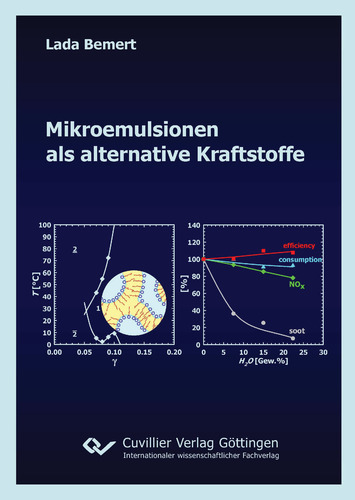
Water–diesel microemulsions were already filed for patent by the University of Cologne in 2003 under the title “Microemulsions and their use as fuel” [DE10334897A1]. Water–diesel microemulsions are thermodynamically stable and form spontaneously. They thus offer decisive advantages over emulsions. In the present work, water–diesel microemulsions were developed with previously unattained efficiency and temperature invariance. Corrosivity and formation kinetics were also decisively improved. Through the use of biogenic components and the transfer of the results from diesel to biogenic fuels such as biodiesel and BTL (biomass to liquid), a decisive contribution to sustainability was made. The systematic combination of the ionic surfactant based on oleic acid and an amine base in conjunction with non-ionic cosurfactants allowed the formulation of highly efficient and temperature-invariant systems of the type: water/freezing-point-depressing component – fuel – amine base/oleic acid/non-ionic cosurfactant. The structure of the newly formulated microemulsions was elucidated by means of small-angle neutron scattering experiments (SANS), transmission electron microscopy images (TEM) and conductivity measurements.
In an intensive and successful collaboration between the universities in Cologne, Dresden, Trier and Karlsruhe, it was possible both to optimise engine parameters and to develop new ideas for injection and exhaust gas aftertreatment technologies. The core result is a reduction of soot emissions of more than 90% with simultaneous NOx reduction using microemulsion fuels. They thereby break through the so-called diesel dilemma, which in engine development is also referred to as the soot–NOx trade-off.
| ISBN-13 (Printausgabe) | 3869550546 |
| ISBN-13 (Hard Copy) | 9783869550541 |
| ISBN-13 (eBook) | 9783736930544 |
| Final Book Format | A5 |
| Language | German |
| Page Number | 280 |
| Lamination of Cover | glossy |
| Edition | 1 Aufl. |
| Volume | 0 |
| Publication Place | Göttingen |
| Place of Dissertation | Universität Köln |
| Publication Date | 2009-07-23 |
| General Categorization | Dissertation |
| Departments |
Mechanical and process engineering
|
| Keywords | Microemulsions, fuels, diesel, Fischer-Tropsch fuels, biodiesel, water, surfactants, pollutant emissions, diesel engines, soot, nitrogen oxides, soot-NOx trade-off, exhaust gas aftertreatment |


