
Cuvillier Verlag GmbH



| Departments | |
|---|---|
| Book Series (99) |
1415
|
| Nachhaltigkeit |
3
|
| Gesundheitswesen |
3
|
| Humanities |
2410
|
| Natural Sciences |
5428
|
| Mathematics | 229 |
| Informatics | 320 |
| Physics | 982 |
| Chemistry | 1371 |
| Geosciences | 131 |
| Human medicine | 246 |
| Stomatology | 10 |
| Veterinary medicine | 112 |
| Pharmacy | 147 |
| Biology | 837 |
| Biochemistry, molecular biology, gene technology | 121 |
| Biophysics | 25 |
| Domestic and nutritional science | 45 |
| Agricultural science | 1005 |
| Forest science | 201 |
| Horticultural science | 20 |
| Environmental research, ecology and landscape conservation | 148 |
| Engineering |
1820
|
| Common |
97
|
|
Leitlinien Unfallchirurgie
5. Auflage bestellen |
|
Advanced Search
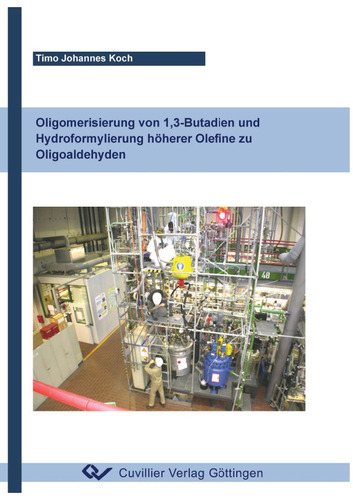
Oligomerisierung von 1,3-Butadien und Hydroformylierung höherer Olefine zu Oligoaldehyden (English shop)
Timo Koch (Author)Preview
Table of Contents, Datei (35 KB)
Extract, Datei (83 KB)
In times of increasingly scarce raw materials and constantly rising requirements for petrochemical products, the search for new routes to organic intermediates is beginning.
Butadiene as a base chemical has attained great technical importance through its polymers. This work describes the transfer of a butadiene oligomerisation from laboratory to pilot scale for the targeted synthesis of oligobutadienes of medium chain length. With the aid of reaction calorimetry and thermodynamic calculations, a pilot plant is designed, built and commissioned. By applying different work-up methods, the influence of reaction parameters and work-up on product quality can thus be investigated. Of particular interest are the viscosity, the polydispersity and the molar masses of the resulting oligomers, as well as the ratio of internal to vinylic double bonds.
In a further reaction step, it is shown how, using carbon dioxide as reaction medium, such oligobutadienes can be selectively functionalised by hydroformylation to give oligoaldehydes. The system is optimised for maximum conversion and product quality, and the perfluoro-modified rhodium catalyst is re-extracted with carbon dioxide from the oligoaldehyde formed as product.
Hydroformylation, as one of the most important homogeneously catalysed reactions, is also the focus of the second part of the work. By introducing a new reaction concept, individual olefins can be selectively hydroformylated in a two-phase system with carbon dioxide and a mixture of α-olefins of different chain lengths. In a catalyst phase with carbon dioxide, the rhodium TPPTS complex known from the Ruhrchemie/Rhône-Poulenc process is immobilised on a basic anion exchanger. Depending on the pressure of the carbon dioxide, the olefins are converted with synthesis gas to aldehydes in the catalyst phase. Thus, using the example of a mixture of 1-octene and 1-octadecene, it can be shown that at pressures up to 100 bar only 1-octene is selectively hydroformylated. In addition, catalyst leaching and the influence of the reaction technique on catalyst activity and selectivity are discussed.
| ISBN-13 (Printausgabe) | 3869550120 |
| ISBN-13 (Hard Copy) | 9783869550121 |
| ISBN-13 (eBook) | 9783736930124 |
| Language | German |
| Page Number | 212 |
| Edition | 1 Aufl. |
| Volume | 0 |
| Publication Place | Göttingen |
| Place of Dissertation | Universität Aachen |
| Publication Date | 2009-06-15 |
| General Categorization | Dissertation |
| Departments |
Chemistry
|


