
Cuvillier Verlag GmbH



| Departments | |
|---|---|
| Book Series (99) |
1415
|
| Nachhaltigkeit |
3
|
| Gesundheitswesen |
3
|
| Humanities |
2412
|
| Natural Sciences |
5430
|
| Mathematics | 230 |
| Informatics | 320 |
| Physics | 982 |
| Chemistry | 1371 |
| Geosciences | 131 |
| Human medicine | 246 |
| Stomatology | 10 |
| Veterinary medicine | 112 |
| Pharmacy | 147 |
| Biology | 837 |
| Biochemistry, molecular biology, gene technology | 121 |
| Biophysics | 25 |
| Domestic and nutritional science | 45 |
| Agricultural science | 1006 |
| Forest science | 201 |
| Horticultural science | 20 |
| Environmental research, ecology and landscape conservation | 149 |
| Engineering |
1821
|
| Common |
97
|
|
Leitlinien Unfallchirurgie
5. Auflage bestellen |
|
Advanced Search
Invertierte und semitransparente organische Solarzellen (English shop)
Hans Schmidt (Author)Preview
Table of Contents, Datei (66 KB)
Extract, Datei (160 KB)
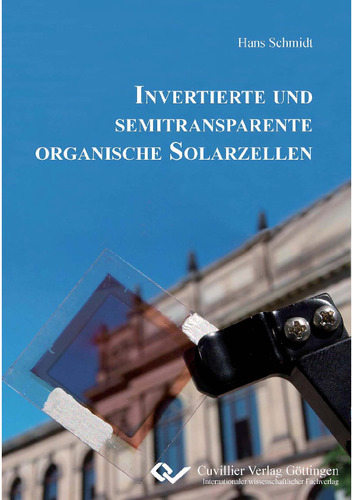
Organic photovoltaics opens up new possibilities for the design of cell modules through the use of organic semiconductors. The low weight of the solar cells and their mechanical properties allow the fabrication of flexible modules, which are already commercially available today (2011) as portable chargers for MP3 players, smart phones or tablet PCs. In addition, the materials employed offer the potential for low-cost production of the solar cells, since no high-temperature process steps or expensive equipment are required during manufacturing.
Moreover, the optical properties of organic semiconductors are advantageous for the realisation of semitransparent solar cells, which partially absorb visible light and transmit part of the light. One potential field of application is functional, tinted window panes which, in glass façades, can provide sun protection (and thermal insulation) while simultaneously generating energy.
The dissertation deals with inverted organic polymer solar cells. Various extraction layers made of transparent conductive oxide semiconductors (TCO) are integrated into the layer stack of the cells and analysed. Based on the findings obtained for the inverted solar cells, semitransparent cells are developed. Both indium tin oxide (ITO) and a multilayer electrode, or sandwich electrode, are investigated as the transparent top contact. Through the use of a molybdenum oxide layer (MoO3), protection of the organic layers during deposition of the top electrode is achieved.
A further focus of the present work is the development of a transparent electrode based on a multilayer structure consisting of a very thin, conductive silver metal layer embedded between two transparent oxide layers of zinc tin oxide (ZTO) with a high refractive index. The structure of this ZAZ electrode is investigated experimentally and the mechanism of charge transport is elucidated. This electrode is also employed as an intermediate contact in tandem solar cells.
| ISBN-13 (Printausgabe) | 3869559853 |
| ISBN-13 (Hard Copy) | 9783869559858 |
| ISBN-13 (eBook) | 9783736939851 |
| Final Book Format | A5 |
| Language | German |
| Page Number | 176 |
| Lamination of Cover | matt |
| Edition | 1 Aufl. |
| Volume | 0 |
| Publication Place | Göttingen |
| Place of Dissertation | Braunschweig |
| Publication Date | 2012-01-27 |
| General Categorization | Dissertation |
| Departments |
Physics
Electrical engineering |
| Keywords | organic solar cells, semitransparent photovoltaics, inverted organic solar cells, multilayer electrode, TCO, condensed matter physics (including solid state physics, optics), general electrical engineering, energy technology, organic electronics, photovoltaics |


