
Cuvillier Verlag GmbH



| Departments | |
|---|---|
| Book Series (99) |
1415
|
| Nachhaltigkeit |
3
|
| Gesundheitswesen |
3
|
| Humanities |
2412
|
| Natural Sciences |
5430
|
| Mathematics | 230 |
| Informatics | 320 |
| Physics | 982 |
| Chemistry | 1371 |
| Geosciences | 131 |
| Human medicine | 246 |
| Stomatology | 10 |
| Veterinary medicine | 112 |
| Pharmacy | 147 |
| Biology | 837 |
| Biochemistry, molecular biology, gene technology | 121 |
| Biophysics | 25 |
| Domestic and nutritional science | 45 |
| Agricultural science | 1006 |
| Forest science | 201 |
| Horticultural science | 20 |
| Environmental research, ecology and landscape conservation | 149 |
| Engineering |
1821
|
| Common |
97
|
|
Leitlinien Unfallchirurgie
5. Auflage bestellen |
|
Advanced Search
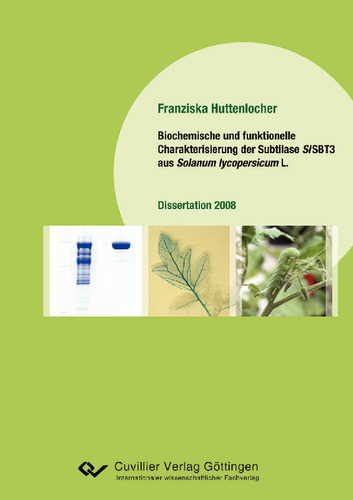
Biochemische und funktionelle Charakterisierung der Subtilase SISBT3 aus Solanum Iycopersicum L (English shop)
Franziska Huttenlocher (Author)Preview
Table of Contents, Datei (36 KB)
Extract, Datei (67 KB)
Subtilases belong to the family of subtilisin-like serine proteases and are widely distributed in both prokaryotic and eukaryotic organisms. In the animal kingdom, subtilases act as proprotein convertases controlling important physiological processes such as the maturation of peptide hormones, growth factors and receptor proteins. The role of subtilases related to the proprotein convertases in plants has so far been described in only a few cases for individual enzymes from Arabidopsis thaliana. Their function in tomato plants is still entirely unclear. Initial results suggest that subtilases play an essential role in the regulation of the wound response and pathogen defence in tomato plants.
The aim of the present work was the functional characterisation of the subtilase SlSBT3 from tomato plants by means of purification and biochemical characterisation of the recombinant protein, detailed expression studies in tomato plants, as well as phenotypic analysis of transgenic plants with altered expression of SlSBT3 (SlSBT3-RNAi and SlSBT3-overexpressing plants).
The subtilase was purified to homogeneity from an SlSBT3-overexpressing tomato cell suspension culture by means of fractionated ammonium sulphate precipitation, cation exchange chromatography in batch mode and anion exchange chromatography. Based on the successful purification of the protein from a homologous system, SlSBT3 could be crystallised and structurally analysed at the Chemical Genomics Centre (Max Planck Institute of Molecular Physiology, Dortmund). Within the scope of the present work, the crystal structure of a plant subtilase could thus be presented for the first time.
The biochemical data showed that SlSBT3 is unusually stable and fully active at temperatures up to 60 °C. At pH 11 the enzyme still exhibited more than 60 % of its proteolytic activity. The purified subtilase was able in vitro to cleave the systemin peptide, an important signalling molecule of the wound response in tomato plants, at a single site, C-terminal of the amino acid Gln16, and thereby to inactivate it. Detailed investigations of the substrate specificity of the enzyme confirmed the preference of recombinant SlSBT3 for glutamine in the P1 position, as well as for basic amino acids in the P2 and P1’ positions of its substrates. The restricted substrate specificity of SlSBT3 suggested that this enzyme is involved in selective protein processing or limited proteolysis and thus fulfils specific tasks in physiological processes in the plant.
Expression of SlSBT3 could be shown in all organs examined, above all in the vascular tissue. Detailed analyses demonstrated SlSBT3 expression in xylem parenchyma and phloem cells, where the precursor protein of systemin is also expressed. The expression of SlSBT3 was induced by mechanical wounding as well as by feeding of Manduca sexta larvae. These findings, namely the inducibility of SlSBT3 expression by wounding, the co-localisation of SlSBT3 and prosystemin and the inactivation of systemin by SlSBT3 shown in vitro, pointed to a possible involvement of the subtilase in the regulation of the wound response in tomato plants. However, this assumption could not be confirmed by a comparison of the activity of wound-induced proteinase inhibitors as marker proteins of insect defence in SlSBT3-RNAi, SlSBT3-overexpressing and wild-type plants.
On the basis of the development of Manduca sexta larvae on SlSBT3-RNAi, SlSBT3-overexpressing and wild-type plants, a possible involvement of SlSBT3 in defence reactions of tomato plants was investigated with regard to a change in the resistance of the plants. Overexpression of SlSBT3 reduced the residence time of Manduca sexta larvae on the host plants. In addition, intact SlSBT3 could be detected in the highly alkaline environment of the gut of Manduca sexta larvae that had fed on SlSBT3-overexpressing plants. These two results, in conjunction with the alkaline pH optimum of the subtilase, are clear indications that SlSBT3 is effective in the digestive tract of insects and could thus play a role in plant defence against herbivores.
The results obtained form the basis for the as yet outstanding complete elucidation of the function of the subtilase SlSBT3 in the defence reaction of tomato plants against herbivores. Moreover, the insights gained from the analysis of the crystal structure of SlSBT3 will also be of decisive importance for research on other plant subtilases and their physiological role.
| ISBN-13 (Printausgabe) | 386727827X |
| ISBN-13 (Hard Copy) | 9783867278270 |
| ISBN-13 (eBook) | 9783736928275 |
| Language | German |
| Page Number | 126 |
| Edition | 1 Aufl. |
| Volume | 0 |
| Publication Place | Göttingen |
| Place of Dissertation | Universität Hohenheim |
| Publication Date | 2008-12-12 |
| General Categorization | Dissertation |
| Departments |
Chemistry
Biology |


