
Cuvillier Verlag GmbH



| Departments | |
|---|---|
| Book Series (99) |
1418
|
| Nachhaltigkeit |
3
|
| Gesundheitswesen |
3
|
| Humanities |
2418
|
| Natural Sciences |
5433
|
| Mathematics | 230 |
| Informatics | 321 |
| Physics | 982 |
| Chemistry | 1371 |
| Geosciences | 131 |
| Human medicine | 247 |
| Stomatology | 10 |
| Veterinary medicine | 112 |
| Pharmacy | 147 |
| Biology | 838 |
| Biochemistry, molecular biology, gene technology | 121 |
| Biophysics | 25 |
| Domestic and nutritional science | 45 |
| Agricultural science | 1006 |
| Forest science | 201 |
| Horticultural science | 20 |
| Environmental research, ecology and landscape conservation | 149 |
| Engineering |
1825
|
| Common |
97
|
|
Leitlinien Unfallchirurgie
5. Auflage bestellen |
|
Advanced Search
Synthese und Strukturen chalkogenverbrückter heterometallischer Bismutverbindungen (English shop)
Heino-Harald Sommer (Author)Preview
Table of Contents, Datei (63 KB)
Extract, Datei (1 MB)
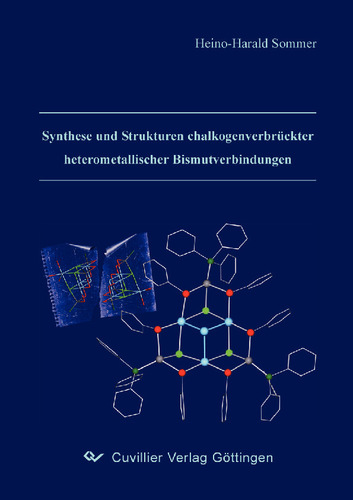
This book focuses on the synthesis and characterisation of novel heterometallic bismuth coinage-metal thiolates and selenolates. It could be shown for the first time that under certain reaction conditions unknown bismuth polyfragments can be stabilised in an unusual environment with the aid of coinage-metal chalcogenolates. The bismuth atoms of the bismuth polyfragments are characterised by subvalent oxidation states. Among the synthesised compounds of this new class of compounds are, inter alia, [Bi2Cu4(SPh)8(PPh3)4], [Bi4Ag3(SePh)6Cl3(PPh3)3]2 and (PPh4)2[Bi10Cu10(SPh)24]. The bismuth atoms form Bi–Bi bonds, so that, for example, a Bi2 dumbbell is present in [Bi2Cu4(SPh)8(PPh3)4]. In the dimeric [Bi4Ag3(SePh)6Cl3(PPh3)3]2 molecules two trigonal Bi4 pyramids are found, and the [Bi10Cu10(SPh)24]2– dianion contains a Bi10 chain. In a purely ionic limiting consideration with M+ (M = Cu, Ag), PhE– (E = S, Se) and Cl–, formal oxidation states can be assigned to the bismuth fragments, so that a Bi2 4+ cation, a Bi4 6+ cation and a Bi10 12+ cation, respectively, are present. DFT calculations were carried out in order to elucidate the charge and bonding situation. The results of the DFT calculations rule out a purely ionogenic view; only the coinage-metal atoms can be characterised as Cu+ or Ag+. The calculated charges indicate that electrons are delocalised from E2– of the EPh– ligand or from X– into the empty 6p AOs of bismuth. Such a bonding situation is most simply described by the presence of three-centre four-electron bonds. If the bismuth atoms in the [Bi10Cu10(SPh)24]2– dianion are idealised as Bi0, the Bi10 fragment corresponds, according to Wade’s rules, to the klado case, for which a branched chain is expected — and which is indeed present in the molecule.
The compounds presented in this work impressively demonstrate the synthesis of a new class of compounds. In these compounds bismuth polyfragments are present whose essential features are the formation of three-centre four-electron bonds to the coinage-metal chalcogen environment and the subvalent oxidation states of the bismuth atoms.
| ISBN-13 (Printausgabe) | 3867278083 |
| ISBN-13 (Hard Copy) | 9783867278089 |
| ISBN-13 (eBook) | 9783736928084 |
| Language | German |
| Page Number | 184 |
| Edition | 1 Aufl. |
| Volume | 0 |
| Publication Place | Göttingen |
| Place of Dissertation | TH Karlsruhe |
| Publication Date | 2008-12-01 |
| General Categorization | Dissertation |
| Departments |
Chemistry
|


