
Cuvillier Verlag GmbH



| Departments | |
|---|---|
| Book Series (99) |
1415
|
| Nachhaltigkeit |
3
|
| Gesundheitswesen |
3
|
| Humanities |
2412
|
| Natural Sciences |
5430
|
| Engineering |
1821
|
| Engineering | 292 |
| Mechanical and process engineering | 872 |
| Electrical engineering | 700 |
| Mining and metallurgy | 30 |
| Architecture and civil engineering | 76 |
| Common |
97
|
|
Leitlinien Unfallchirurgie
5. Auflage bestellen |
|
Advanced Search
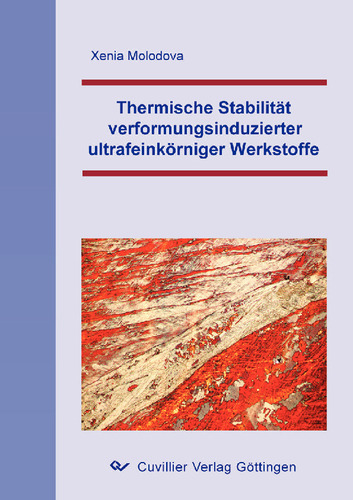
Thermische Stabilität verformungsinduzierter ultrafeinkörniger Werkstoffe (English shop)
Xenia Molodova (Author)Preview
Table of Contents, Datei (29 KB)
Extract, Datei (31 KB)
Thermal Stability of Deformation-Induced Ultrafine-Grained Materials
Ultrafine-grained materials are characterized by improved mechanical properties. This advantage would, however, be lost if structural coarsening set in during the production, processing or application of these materials as a result of heat input, for example during joining. A stable UFG microstructure is therefore of great interest for applications.
In the present work, the microstructure and texture evolution of Cu and Al materials during ECAP deformation and subsequent annealing treatment was investigated. The results have shown that, depending on the material, an ultrafine-grained microstructure with a mean grain size of around 400–500 nm can be established during ECAP deformation.
Overall, however, it became clear that even under very severe deformation, such as 12 ECAP passes, no microstructure can be established that is free of essential elements of a deformed structure, such as a high, inhomogeneously distributed dislocation density and a high proportion of low-angle grain boundaries. The apparently ultrafine-grained material therefore inevitably tends towards discontinuous recrystallization. A stabilization of the structure can thus only be achieved by eliminating the deformation elements (dislocations, cell boundaries), for example through massive recovery during low-temperature annealing, or by alloying with chemical elements that strongly restrict the migration of grain boundaries. In this context, the temperature regime represents an important control element for thermal stability, in which precipitation processes and recovery processes can be deliberately employed in order to influence softening to a considerable extent. A high thermal stability is in turn a decisive prerequisite for potential applications of UFG materials.
| ISBN-13 (Printausgabe) | 3867277389 |
| ISBN-13 (Hard Copy) | 9783867277389 |
| ISBN-13 (eBook) | 9783736927384 |
| Language | German |
| Page Number | 170 |
| Edition | 1 Aufl. |
| Volume | 0 |
| Publication Place | Göttingen |
| Place of Dissertation | TH Aachen |
| Publication Date | 2008-09-19 |
| General Categorization | Dissertation |
| Departments |
Engineering
|
| Keywords | ECAP, EBSD, TEM, texture, recrystallization |


