
Cuvillier Verlag GmbH



| Departments | |
|---|---|
| Book Series (99) |
1415
|
| Nachhaltigkeit |
3
|
| Gesundheitswesen |
3
|
| Humanities |
2412
|
| Natural Sciences |
5430
|
| Mathematics | 230 |
| Informatics | 320 |
| Physics | 982 |
| Chemistry | 1371 |
| Geosciences | 131 |
| Human medicine | 246 |
| Stomatology | 10 |
| Veterinary medicine | 112 |
| Pharmacy | 147 |
| Biology | 837 |
| Biochemistry, molecular biology, gene technology | 121 |
| Biophysics | 25 |
| Domestic and nutritional science | 45 |
| Agricultural science | 1006 |
| Forest science | 201 |
| Horticultural science | 20 |
| Environmental research, ecology and landscape conservation | 149 |
| Engineering |
1821
|
| Common |
97
|
|
Leitlinien Unfallchirurgie
5. Auflage bestellen |
|
Advanced Search
Komplexe zweiwertiger Lanthanoide und Erdalkalimetalle und neue Bindungen mit Metallen der Gruppe 13 (English shop)
Michal Wiecko (Author)Preview
Table of Contents, Datei (38 KB)
Extract, Datei (150 KB)
The discovery of unusual, low-valent group 13 compounds such as [(C5Me5)Al]4 or [(C5Me5)Ga]6 in the 1990s has inspired many research groups. Theoretical investigations show that the (C5Me5)E monomer (E = Al, Ga, In) can be regarded as isolobal to CO and PR3. In transition metal chemistry, a number of compounds with (C5Me5)E fragments as ligands are known. Since the HOMO of (C5Me5)Al corresponds to a lone pair of electrons, it can act as a Lewis base. As pure Lewis acid-base adducts without back-bonding contributions, until recently only E-E´ molecules such as [(C5Me5)Al→B(C6F5)3] or [(C5Me5)Ga→GaR3] were known. Adducts of weakly bound (C5Me5)Al to [(C5Me5)2Yb] and [(C5Me5)2Eu] were only recently prepared in the Roesky group. The metal-metal bonds are largely electrostatic and without covalent contributions.
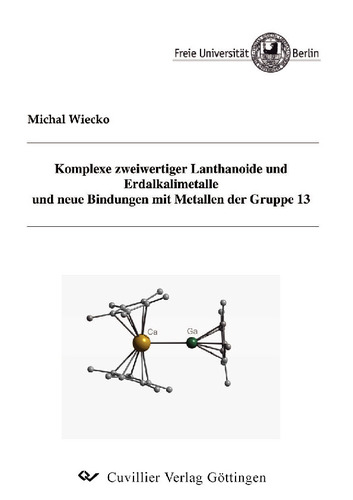
In this work, the reactions of [(C5Me5)E] (E = Al, Ga, In) with the donor-free metallocenes [(C5Me5)2M] (M = Ca, Sr, Ba, Eu, Yb) were investigated. The first known compounds with metal-metal bonds of the elements Sr, Ba, Eu and Yb to gallium could be characterised. By slow crystallisation from solution, up to two (C5Me5)Ga fragments were coordinated to the corresponding metal centre; in some cases a THF molecule remains in the complex (Scheme I).
The M-Ga bonds are only weak in this case. In NMR and MS spectra, only signals characteristic of the individual fragments are found.
In contrast, the reaction of [(C5Me5)In] with [(C5Me5)2Ba] led, presumably via a radical mechanism, to a compound with intramolecular Ba-olefin contacts (Scheme II).
As a second topic, new compounds of divalent lanthanides with a bis(phosphinimino)methanide ligand were prepared, and the anion BPh4- was introduced into such systems for the first time (Scheme III).
Introductory studies on the catalytic activity in hydroamination reactions and the polymerisation of ε-caprolactone were carried out with SmII compounds. The ionic compound [{CH(PPh2NSiMe3)2}Eu(THF)3]BPh4 was successfully employed in subsequent reactions and may offer a new possibility for the synthesis of otherwise hardly accessible complexes.
| ISBN-13 (Printausgabe) | 3867276897 |
| ISBN-13 (Hard Copy) | 9783867276894 |
| ISBN-13 (eBook) | 9783736926899 |
| Language | German |
| Page Number | 90 |
| Edition | 1 Aufl. |
| Volume | 0 |
| Publication Place | Göttingen |
| Place of Dissertation | FU Berlin |
| Publication Date | 2008-08-13 |
| General Categorization | Dissertation |
| Departments |
Chemistry
|
| Keywords | Low-valent compounds, metal–metal bonds |


