
Cuvillier Verlag GmbH



| Departments | |
|---|---|
| Book Series (99) |
1415
|
| Nachhaltigkeit |
3
|
| Gesundheitswesen |
3
|
| Humanities |
2410
|
| Natural Sciences |
5428
|
| Mathematics | 229 |
| Informatics | 320 |
| Physics | 982 |
| Chemistry | 1371 |
| Geosciences | 131 |
| Human medicine | 246 |
| Stomatology | 10 |
| Veterinary medicine | 112 |
| Pharmacy | 147 |
| Biology | 837 |
| Biochemistry, molecular biology, gene technology | 121 |
| Biophysics | 25 |
| Domestic and nutritional science | 45 |
| Agricultural science | 1005 |
| Forest science | 201 |
| Horticultural science | 20 |
| Environmental research, ecology and landscape conservation | 148 |
| Engineering |
1821
|
| Common |
97
|
|
Leitlinien Unfallchirurgie
5. Auflage bestellen |
|
Advanced Search
Konfokale Einzelpartikel-Detektion von fluoreszenz-kodierten Nanospheres. (English shop)
Hendrik Hippchen (Author)Preview
Table of Contents, Datei (47 KB)
Extract, Datei (110 KB)
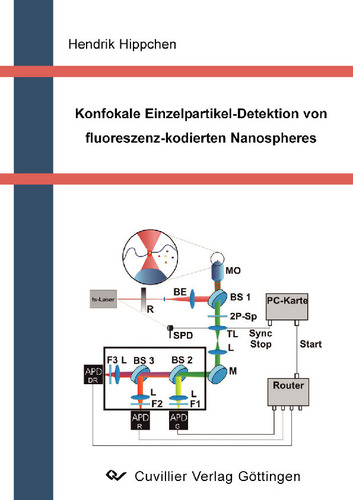
The aim of this work was to identify and characterise individual fluorescence-encoded nanoparticles of 20–40 nm in size during diffusive transits through a confocal focal volume with a radius of 200–300 nm. The background is that such encoding allows a large number of different receptor–ligand interactions to be investigated within a short time in a single parallel reaction batch, which is particularly advantageous in high-throughput procedures such as DNA analysis or the analysis of glycoconjugates. To this end, a confocal microscope apparatus with a pulsed Ti:Sa laser source for two-photon excitation was first set up, and on the detection side the emitted fluorescence was recorded separately in three spectral regions. The data obtained from the measurements were then evaluated using self-programmed software. For the parallelised measurements, effective identification algorithms had to be programmed, evaluated and tested. This required finding suitable characteristics of the occurring photon bursts for differentiation and analysing the available nanoparticles in this respect. The absorption and emission spectra of the particles showed that, in the multiply stained types, effectively only the longest-wavelength emitting fluorophore emits photons, particularly under two-photon excitation. It turned out that effective Förster resonance energy transfer (FRET) processes are responsible for this, favoured by large spectral overlaps and small fluorophore separations within the particles. Since the discrimination of multiply stained particle types on the basis of their fluorescence emissions is impeded by FRET processes, the parallel discrimination of singly stained types was investigated first. For these types, filter distributions of the identification parameters were then recorded through multiple measurements of type-pure samples, and it was estimated to what extent the identification algorithms should be capable of distinguishing them. In order to quantify the influences of burst overlaps and peripheral passages, a simulation was programmed and the various algorithms were applied to the resulting time traces. The efficiency of different algorithms in differentiating the individual types was then first tested on five single-particle systems, whereby an almost one hundred per cent identification was achieved. The application of the algorithms to all possible permutations of multi-component systems showed in part slightly higher error rates than for the single-component systems; nevertheless, individual nanoparticles could still be identified with a confidence of more than 95 %. Further interesting phenomena could be observed in the analysis of individual fluorescence bursts. Thus, measurements of the fluorescence lifetime on ensembles of some particles and of the single-burst fluorescence lifetime of all particles showed a dependence on the excitation power. The reason for this lies in the increase of extremely effective additional FRET pathways of excited states. In addition, effects on the fluorescence lifetime as a function of particle size were observed. The comparison of particles of different sizes showed a reduction of the lifetime with increasing particle size, which is caused by the change in the population ratios in favour of the faster relaxing fluorophores in the sphere core. Further effects on the components of the fluorescence decay dynamics could be explained by altered geometry and multiple homo-energy transfer. The autocorrelation analysis revealed a strongly type-specific dependence of the focal volume on the laser power, which was proportional to the respective excitability of the particles. In summary, it was possible to develop extremely efficient identification algorithms for diffusive transits of individual nanoparticles. Future work will address the selective functionalisation of the different particles with different ligands and parallelised measurements of their interactions with target molecules such as lectins. In a study published in ChemBioChem 12, our research group has already been able to show that the functionalisation of singly stained nanoparticles with different oligosaccharides permits the measurement of relative lectin binding affinities. With the method developed in this work, these measurements can now be extended to the simultaneous measurement of affinities and cross-affinities of entire oligosaccharide libraries. The differentiation problem caused by FRET processes in multiply stained nanoparticles will, in future developments, be circumvented by selective excitation of the different absorption bands, which can also be used as an encoding feature.
| ISBN-13 (Printausgabe) | 3867276064 |
| ISBN-13 (Hard Copy) | 9783867276061 |
| ISBN-13 (eBook) | 9783736926066 |
| Language | German |
| Page Number | 152 |
| Edition | 0 |
| Volume | 0 |
| Publication Place | Göttingen |
| Place of Dissertation | Braunschweig |
| Publication Date | 2008-06-03 |
| General Categorization | Dissertation |
| Departments |
Chemistry
|
| Keywords | Physical chemistry, nuclear chemistry. |


