
Cuvillier Verlag GmbH



| Departments | |
|---|---|
| Book Series (99) |
1415
|
| Nachhaltigkeit |
3
|
| Gesundheitswesen |
3
|
| Humanities |
2410
|
| Medienwissenschaften | 17 |
| Theology | 57 |
| Philosophy | 103 |
| Law | 430 |
| Economics | 863 |
| Social sciences | 423 |
| Sports science | 48 |
| Psychology | 233 |
| Educational science | 190 |
| History | 194 |
| Art | 111 |
| Cultural studies | 167 |
| Literary studies | 118 |
| Linguistics | 90 |
| Natural Sciences |
5428
|
| Engineering |
1821
|
| Common |
97
|
|
Leitlinien Unfallchirurgie
5. Auflage bestellen |
|
Advanced Search
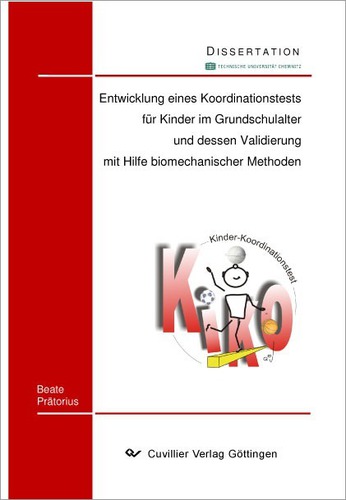
Entwicklung eines Koordinationstests für Kinder im Grundschulalter und dessen Validierung mit Hilfe biomechanischer Methoden (English shop)
Beate Prätorius (Author)Preview
Table of Contents, Datei (25 KB)
Extract, Datei (73 KB)
The current situation regarding the motor and, in particular, coordinative performance of children, as well as the analysis of the literature on the topics of the health-related and psychosocial consequences of motor deficits, justifies the demand for adequate test procedures for coordinative abilities. A review of existing tests clearly reveals a lack of valid, up-to-date and theoretically substantiated test procedures. A test of coordinative abilities whose quality has been demonstrated and which actually confines itself to assessing purely coordinative ability domains does not exist. The development of a test procedure for coordinative abilities whose quality has been scientifically verified must therefore be demanded. Validity, understood here as the content validity of the test, is of primary importance. If it is not demonstrated, the entire test must be called into question. In addition, the discussion of findings from developmental physiology and of attempts to structure coordinative abilities yields results relevant to the conceptual foundations of the new test procedure for coordinative abilities, the Children’s Coordination Test (Kinder-Koordinationstest, KiKo).
The development of a purely coordinative test procedure is regarded as necessary and is the aim of the present work. On the basis of Hirtz’s five coordinative abilities, a coordination test for children of primary school age is developed, whose validity is to be demonstrated empirically by means of biomechanical methods. To ensure general applicability, the remaining quality criteria are also examined.
Methods
Corresponding to the five coordinative abilities, five test tasks were developed, each of which incorporates as its dominant characteristic the ability of differentiation, rhythmisation, maintenance of balance, orientation and reaction. Validation using biomechanical methods is the main focus.
For the validation, samples of between 25 and 70 children from primary schools were used in each case. All the children were between six and eleven years of age, with a relatively balanced ratio both between the individual age groups and between the sexes. The children were each familiarised with the test task and the measuring system, so that neither comprehension problems nor anxiety could arise. In addition, studies were conducted to examine further quality criteria.
Results and discussion
The results show a high validity of the test tasks developed. Apart from the test of orientation ability, correlation coefficients of r > .7 were achieved throughout. The validity of the tests can be regarded as assured. Owing to its complex character, the test of orientation ability was unable to achieve such a high validity, but it is nevertheless considered useful as a point of reference for support measures or further investigations: its application permits a better statement than its omission. Satisfactory results were also obtained for objectivity, reliability, usefulness and economy.
Outlook
In any case, these investigations have opened up new possibilities in test development: interdisciplinary work can increase the quality of sport motor test procedures as well as their informative value. Moreover, with the Children’s Coordination Test, an extraction of exclusively coordinative abilities has been undertaken for the first time, enabling a differentiated examination of coordination ability. Furthermore, the test is easy to administer and, with the aid of the norm table that has been created, offers every school the opportunity to obtain indications of existing deficits in the coordinative domain. With the help of further work on the Children’s Coordination Test, it may under certain circumstances even be possible, by adding strength and endurance tests, to establish comparability with the KTK and thus with data from the last 30 years. Overall, the aim is to gain further insights into the nature of the construct “coordination” with the new test procedure and to make a contribution to the fight against motor deficits with all their health-related consequences.
| ISBN-13 (Printausgabe) | 3867275661 |
| ISBN-13 (Hard Copy) | 9783867275668 |
| ISBN-13 (eBook) | 9783736925663 |
| Final Book Format | A5 |
| Language | German |
| Page Number | 192 |
| Edition | 1 |
| Volume | 0 |
| Publication Place | Göttingen |
| Place of Dissertation | Chemnitz |
| Publication Date | 2008-04-16 |
| General Categorization | Dissertation |
| Departments |
Sports science
Educational science |
| Keywords | Coordination, coordination ability, coordination test, coordinative abilities, motor test, motor skills, motor abilities, validity. |


