
Cuvillier Verlag GmbH



| Departments | |
|---|---|
| Book Series (99) |
1415
|
| Nachhaltigkeit |
3
|
| Gesundheitswesen |
3
|
| Humanities |
2411
|
| Natural Sciences |
5429
|
| Mathematics | 230 |
| Informatics | 320 |
| Physics | 982 |
| Chemistry | 1371 |
| Geosciences | 131 |
| Human medicine | 246 |
| Stomatology | 10 |
| Veterinary medicine | 112 |
| Pharmacy | 147 |
| Biology | 837 |
| Biochemistry, molecular biology, gene technology | 121 |
| Biophysics | 25 |
| Domestic and nutritional science | 45 |
| Agricultural science | 1005 |
| Forest science | 201 |
| Horticultural science | 20 |
| Environmental research, ecology and landscape conservation | 148 |
| Engineering |
1821
|
| Common |
97
|
|
Leitlinien Unfallchirurgie
5. Auflage bestellen |
|
Advanced Search
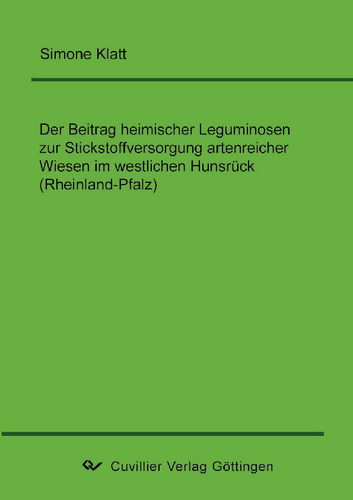
Der Beitrag heimischer Leguminosen zur Stickstoffversorgung artenreicher Wiesen im westlichen Hunsrück (Rheinland-Pfalz) (English shop)
Simone Klatt (Author)Preview
Table of Contents, Datei (32 KB)
Extract, Datei (71 KB)
This multi-year study focuses on species-rich hay meadows (Arrhenatheretum of the nutrient-poor variant) on calcium-poor soils of the western Hunsrück near Trier (Rhineland-Palatinate, Federal Republic of Germany). The occurrence of this formerly widespread grassland type is declining throughout Germany as a result of intensification measures or land abandonment. Owing to their diversity of plant species, these meadows make a substantial contribution to maintaining a high level of biodiversity and to a varied landscape.
The semi-extensively managed, relatively nutrient-poor meadows show a more or less pronounced occurrence of nitrogen-fixing plants. The legumes Trifolium pratense, T. repens, T. dubium, Lotus corniculatus, Lathyrus linifolius, Vicia cracca and V. sepium are found in these meadows with high constancy.
Knowledge of the magnitude of symbiotic nitrogen fixation by legumes is of great importance in agricultural practice in order to draw up as accurate an N balance as possible for the respective areas. This not only serves to reduce costs (less fertiliser) but also contributes to groundwater protection as well as to landscape and biotope conservation. One focus of the investigations was therefore the determination of the mass proportions of legumes in the plant stand and the quantification of the amounts of symbiotically fixed N. These were calculated on the basis of the natural occurrence of the stable 15N isotope using the semi-quantitative δ15N method (15N natural abundance method). The results of the investigations are intended to contribute to a better understanding of the significance of the functional group of legumes for the nitrogen budget of nutrient-poor meadows.
| ISBN-13 (Printausgabe) | 3867275645 |
| ISBN-13 (Hard Copy) | 9783867275644 |
| ISBN-13 (eBook) | 9783736925649 |
| Final Book Format | A5 |
| Language | German |
| Page Number | 204 |
| has Fold-Out Page | Yes |
| Edition | 1 |
| Volume | 0 |
| Publication Place | Göttingen |
| Place of Dissertation | Trier |
| Publication Date | 2008-04-14 |
| General Categorization | Dissertation |
| Departments |
Biology
|
| Keywords | 15N natural abundance method, Fabaceae, legumes, Trifolium, Lotus, Vicia, Lathyrus, symbiotic nitrogen fixation, haymeadows, B-value, extensively managed grassland. |


