
Cuvillier Verlag GmbH



| Departments | |
|---|---|
| Book Series (99) |
1415
|
| Nachhaltigkeit |
3
|
| Gesundheitswesen |
3
|
| Humanities |
2413
|
| Medienwissenschaften | 17 |
| Theology | 57 |
| Philosophy | 103 |
| Law | 430 |
| Economics | 864 |
| Social sciences | 423 |
| Sports science | 48 |
| Psychology | 233 |
| Educational science | 190 |
| History | 194 |
| Art | 111 |
| Cultural studies | 168 |
| Literary studies | 119 |
| Linguistics | 91 |
| Natural Sciences |
5430
|
| Engineering |
1822
|
| Common |
97
|
|
Leitlinien Unfallchirurgie
5. Auflage bestellen |
|
Advanced Search
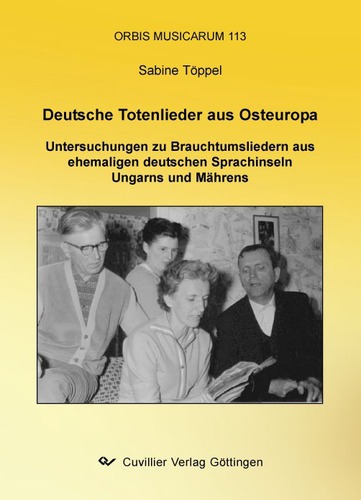
Deutsche Totenlieder aus Osteuropa (Volume 113) (English shop)
Untersuchungen zu Brauchtumsliedern aus ehemaligen deutschen Sprachinseln
Sabine Töppel (Author)Preview
Table of Contents, Datei (26 KB)
Extract, Datei (53 KB)
So-called “Totenlieder” (“songs of the dead”) are songs of customary practice that were sung by the mourners outside the liturgy. They are to be classified within the genre of “sacred folk songs”, here under the designation “Totenlieder according to function” (some songs were also sung as pilgrimage or bridal songs).
They are strophic songs with a rich occurrence of stepwise intervals, for the most part within the ambitus of an octave. Varying regionally, the songs in Deutsch-Mokra (Carpatho-Ukraine) were predominantly in minor, in Rudolfsgnad (Yugoslav Banat) and in the Sudetenland predominantly in major, while in the Sudetenland much was also sung in two parts in triadic harmony.
The text, which is mostly set syllabically to the melody, differs in content in several respects: it is either of a general nature (heroic epic, reflections on life and transience, dance-of-death song, etc.), or it expresses very personal thoughts, which in turn are either put into the mouth of the deceased person or are to be conveyed by the relatives.
These distinctions result in the following regional peculiarities: In Deutsch-Mokra (founded 1775), whose emigrants were forestry workers from Upper Austria, singing took place during the wake in the house of the deceased. These were communal songs, in which songs with many stanzas and general content were sung in order to keep vigil through the night.
In Rudolfsgnad (founded 1866), whose emigrants had come since 1718 as farmers predominantly from Bavaria and the Palatinate, very personal songs were sung only at the house of the deceased in the yard after the blessing of the body and at the grave before or after the lowering of the coffin. They were performed by a single person, mostly after the Latin songs prescribed by the liturgy. In these songs either the deceased person took leave of the individual relatives, or the bereaved expressed their grief and their farewell wishes.
In the other regions documented here – Hauerland, Sudetenland or the Volga region – singing was reported predominantly at the grave, in isolated cases also after the blessing of the body in the yard at the house of the deceased.
The melodies were always transmitted orally, frequently being adapted to the personal texts and altered in the process, which is why their age and origin can no longer be determined precisely.
The texts, by contrast, have been handed down in writing since the late 17th century through broadsheets, rarely also in a hymnal, but mostly through the repeated copying into the respective personal song booklets.
With the help of these “sacred folk songs”, people in former times preserved for themselves the possibility of expressing their popular piety not only in prayers or liturgical chants, but also, beyond the strict ecclesiastical order and precisely in the personal songs, of proclaiming their reverence for God and their hope of a reunion with their dear departed in heaven.
| ISBN-13 (Printausgabe) | 386727519X |
| ISBN-13 (Hard Copy) | 9783867275194 |
| ISBN-13 (eBook) | 9783736925199 |
| Language | German |
| Page Number | 274 |
| Edition | 1 |
| Book Series | Orbis Musicarum |
| Volume | 113 |
| Publication Place | Göttingen |
| Place of Dissertation | Göttingen |
| Publication Date | 2008-02-14 |
| General Categorization | Dissertation |
| Departments |
Art
|


