
Cuvillier Verlag GmbH



| Departments | |
|---|---|
| Book Series (99) |
1415
|
| Nachhaltigkeit |
3
|
| Gesundheitswesen |
3
|
| Humanities |
2414
|
| Medienwissenschaften | 17 |
| Theology | 57 |
| Philosophy | 103 |
| Law | 430 |
| Economics | 865 |
| Social sciences | 423 |
| Sports science | 48 |
| Psychology | 233 |
| Educational science | 190 |
| History | 194 |
| Art | 111 |
| Cultural studies | 168 |
| Literary studies | 119 |
| Linguistics | 91 |
| Natural Sciences |
5432
|
| Engineering |
1822
|
| Common |
97
|
|
Leitlinien Unfallchirurgie
5. Auflage bestellen |
|
Advanced Search
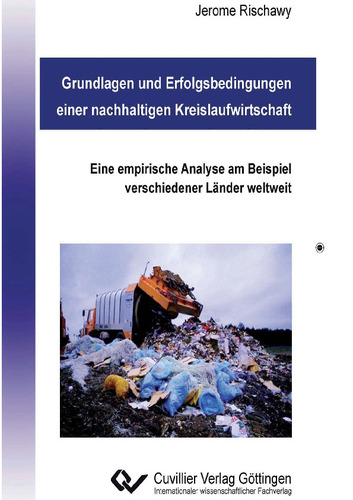
Grundlagen und Erfolgsbedingungen einer nachhaltigen Kreislaufwirtschaft (English shop)
Eine empirische Analyse am Beispiel verschiedener Länder weltweit
Jerome Rischawy (Author)Preview
Table of Contents, Datei (31 KB)
Extract, Datei (110 KB)
Building on the fundamentals of a stably functioning circular economy, the practical part of the study conducts an empirical investigation into both the obstacles to and the conditions for the success of a sustainable waste management sector, that is, one shaped by economic, ecological and also social considerations. To this end, an attempt was made — by drawing up a catalogue of questions that was submitted to the waste management experts of the Fichtner group and by conducting additional interviews — to determine which criteria a functioning circular economy depends on in the respective project countries. Building on this, various projects of Fichtner GmbH & Co. KG were furthermore examined in greater depth.
From the entirety of all the investigations it was ultimately possible to filter out concrete problems, obstacles and conditions for success, which were in part more and in part less pronounced in the various countries and regions. The decisive point here, however, is that the fundamental challenges appear to be the same all over the world, albeit to a greater or lesser degree. Without doubt, in many regions of the world waste management is only at the beginning of its development and numerous problems and challenges exist that need to be overcome. Not least, this is frequently also reflected in vague legal frameworks, non-existent waste management concepts, an ambiguous enforcement practice, as well as a lack of know-how.
Furthermore, it is certainly also possible, by means of stricter requirements and sanctions, to achieve a certain deterrent effect in the short term. Yet this alone does not permanently eliminate or address the core, or rather the cause, of the problem. The most fundamental and most important challenge in fact lies in people themselves and in their awareness. For without a general change in awareness and environmental education — through the education system or campaigns, for instance — towards a holistic way of thinking about the environment and waste, no change can in principle take place. This is the starting point of everything else. It must be borne in mind here, however, that other factors do indeed also play a role in setting this awareness in motion, or rather in consolidating and internalising it.
Certain behavioural incentives play a not inconsiderable role in this respect, since small tokens of appreciation can ultimately achieve by far more in addition than merely warm and insistent words. In this connection, however, it must also be considered that it is frequently assumed that in some countries the problem is to be sought solely in a wrong mentality of the people, while it is often overlooked that people simply have no opportunity either, because funds are lacking for the establishment of a sophisticated infrastructure. A sophisticated infrastructure, however, is very expensive owing to high investment and operating costs, and causes waste charges to soar, or increasingly prompts the respective countries to introduce such charges where they do not yet exist. Here, further international projects should continue to lend support, particularly to emerging and developing countries, and provide help towards self-help.
At the same time, it must never be forgotten that even a country such as Germany needed a good four decades to manoeuvre its waste management sector to where it stands today. Against this background, it is very important to bear in mind that everything that is once begun requires time before it gets going and can be maintained sustainably and routinely in the sense of a continuous improvement process (CIP).
| ISBN-13 (Printausgabe) | 3869557842 |
| ISBN-13 (Hard Copy) | 9783869557847 |
| ISBN-13 (eBook) | 9783736937840 |
| Final Book Format | A5 |
| Language | German |
| Page Number | 458 |
| Lamination of Cover | matt |
| Edition | 1 Aufl. |
| Volume | 0 |
| Publication Place | Göttingen |
| Place of Dissertation | Hohenheim |
| Publication Date | 2011-12-12 |
| General Categorization | Dissertation |
| Departments |
Economics
|
| Keywords | Waste and circular economy, waste, sustainability, environmental and waste awareness, environmental education, behavioural incentives, infrastructure, separate collection system, landfill, recycling, thermal waste treatment, composting, anaerobic digestion, mechanical biological waste treatment |


