
Cuvillier Verlag GmbH



| Departments | |
|---|---|
| Book Series (99) |
1415
|
| Nachhaltigkeit |
3
|
| Gesundheitswesen |
3
|
| Humanities |
2410
|
| Natural Sciences |
5428
|
| Mathematics | 229 |
| Informatics | 320 |
| Physics | 982 |
| Chemistry | 1371 |
| Geosciences | 131 |
| Human medicine | 246 |
| Stomatology | 10 |
| Veterinary medicine | 112 |
| Pharmacy | 147 |
| Biology | 837 |
| Biochemistry, molecular biology, gene technology | 121 |
| Biophysics | 25 |
| Domestic and nutritional science | 45 |
| Agricultural science | 1005 |
| Forest science | 201 |
| Horticultural science | 20 |
| Environmental research, ecology and landscape conservation | 148 |
| Engineering |
1820
|
| Common |
97
|
|
Leitlinien Unfallchirurgie
5. Auflage bestellen |
|
Advanced Search
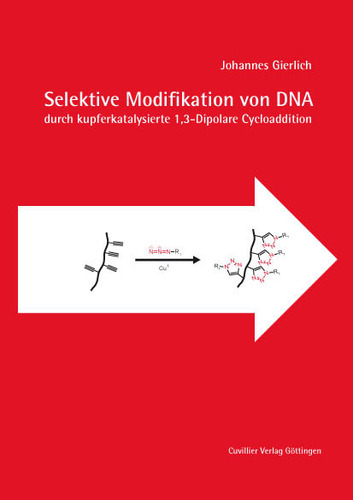
Selektive Modifikation von DNA durch kupferkatalysierte 1,3-Dipolare Cycloaddition (English shop)
Johannes Gierlich (Author)Preview
Table of Contents, Datei (63 KB)
Extract, Datei (260 KB)
The introduction of functional groups into DNA while preserving base pairing and enzymatic processability is an important means of generating DNA with new properties for new applications. The aim of this work was the functionalisation of DNA with aldehydes for the deposition of silver by means of the Tollens reaction. In this context, not only the direct incorporation of aldehyde-modified monomers was investigated, but also the functionalisation of DNA by means of the copper(I)-catalysed 1,3-dipolar cycloaddition of azides and alkynes (“click” chemistry). This only recently discovered reaction is characterised by high rate, high yield, high tolerance of functional groups and simple handling. The reaction has already been used successfully in many areas of chemistry and biochemistry.
In order to investigate the compatibility of the reaction with DNA, alkyne-modified thymidines were incorporated into short DNA strands by solid-phase synthesis. Examination of the products of the cycloaddition under various conditions showed that stabilisation of the Cu(I) ions by special ligands, such as tribenzyltriazolamine (TBTA), was necessary. The direct addition of CuBr as a copper(I) source without a reducing agent gave the best results. Under these conditions, it was possible to convert six consecutive alkynes quantitatively with various azides. The range of functions introduced extended from fluorescent dyes such as fluorescein to metal-reducing groups such as sugars. A certain distance between the alkyne and the base was essential for quantitative conversion in the case of the single strands. Even the reaction on DNA strands of up to 2000 base pairs in length bearing only two alkynes each could be carried out without damage to the DNA.
Alkyne DNA was moreover successfully used in microcontact printing on azide-modified glass surfaces. In order to immobilise the DNA without disturbing its structure, new solid-phase monomers for terminal alkynes were synthesised. This alkyne DNA was subsequently hybridised successfully on the surface with a fluorescently labelled complementary strand.
For the preparation of long DNA strands (2000 base pairs) with a high density of aldehydes, triphosphates bearing aldehydes or alkynes were synthesised. These substituted the corresponding natural triphosphate in the PCR. In the case of the aldehyde triphosphates, the liberation of the aldehydes, which were protected as acetals, was not possible without damage to the DNA. A building block with an acetyl-protected sugar as the aldehyde component showed selective metal deposition. However, these sterically demanding substrates proved to be poor substrates for the polymerases in the PCR.
Triphosphates with alkynes were accepted considerably better by the polymerases. Thus, using 5-(1,7-octadiynyl)-2’-deoxyuridine or 5-(1,7-octadiynyl)-2’-deoxycytidine triphosphate, PCR products up to 2000 base pairs in length bearing almost 900 alkynes were prepared. The alkyne bases led to a marked stabilisation of the DNA. Functionalisation of the PCR products with a galactose azide and subsequent enzymatic digestion to the monomers showed quantitative conversion for the alkyne cytidine. In the case of PCR products with alkyne uridines, at least 95 % of the alkynes reacted. The aldehyde DNA could be detected selectively and very sensitively by silver staining on polyacrylamide gels or membranes. Aldehyde-modified PCR products were coated with silver or gold. The selectivity and the quality of the metal deposition were investigated by AFM or STM.
| ISBN-13 (Printausgabe) | 3867273138 |
| ISBN-13 (Hard Copy) | 9783867273138 |
| ISBN-13 (eBook) | 9783736923133 |
| Final Book Format | A5 |
| Language | German |
| Page Number | 252 |
| Edition | 1 |
| Volume | 0 |
| Publication Place | Göttingen |
| Place of Dissertation | München |
| Publication Date | 2007-08-02 |
| General Categorization | Dissertation |
| Departments |
Chemistry
Pharmacy |
| Keywords | DNA, polymerase chain reaction, click chemistry, cycloaddition. |


