
Cuvillier Verlag GmbH



| Departments | |
|---|---|
| Book Series (99) |
1418
|
| Nachhaltigkeit |
3
|
| Gesundheitswesen |
3
|
| Humanities |
2418
|
| Natural Sciences |
5433
|
| Engineering |
1825
|
| Engineering | 292 |
| Mechanical and process engineering | 875 |
| Electrical engineering | 701 |
| Mining and metallurgy | 30 |
| Architecture and civil engineering | 76 |
| Common |
97
|
|
Leitlinien Unfallchirurgie
5. Auflage bestellen |
|
Advanced Search
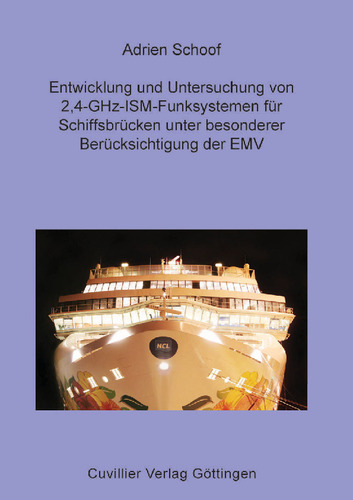
Entwicklung und Untersuchung von 2,4-GHz-ISM-Funksystemen für Schiffsbrücken unter besonderer Berücksichtigung der EMV (English shop)
Adrien Schoof (Author)Preview
Table of Contents, Datei (31 KB)
Extract, Datei (170 KB)
In recent years, wireless data transmission standards have become increasingly established in the field of consumer and data processing electronics. In particular, the Bluetooth and WLAN standards have achieved a high degree of dissemination in a wide variety of application areas. In doing so, they not only replace cumbersome and expensive cables, but also constitute a new generation of interfaces between devices that previously could not be networked.
Given the great cable lengths used in shipbuilding as well as the high cable densities in the area of marine electronics, it appears sensible to employ wireless data transmission devices in this application area as well. A significant reduction in cabling costs, as well as considerably greater flexibility in installation, conversion and retrofitting compared with conventional cabling, would be the advantages. Essential for the use of wireless technologies in shipbuilding is ensuring the electromagnetic compatibility (EMC) and the reliability of the radio transmission modules employed in the “ship” environment. Owing to the large number of radio services present, the electromagnetic particularities of the predominantly metallic basic structure and the large number of measuring and display devices as well as open- and closed-loop control components, ships represent a special application area.
In the present work, commercially available Bluetooth and WLAN radio transmission modules are examined with regard to their suitability as cable replacements in shipbuilding, in particular on ships’ bridges. To this end, extensive investigations of the electromagnetic compatibility of the modules are presented. Detailed measurements were carried out of the emission of electromagnetic radiation from radio transmitters, of the superposition of the resulting frequency spectra with those of other sources, as well as measurements and simulations of the coupling of the radiation into conductive structures. At the same time, a detailed characterisation of the electromagnetic environment on ships was undertaken. For this purpose, the existing background radiation was measured and analysed on board cruise ships, ferries, cargo ships and naval vessels.
Of particular interest is the immunity of radio transmission systems under the influence of radar installations. Investigations were carried out on board ships as well as on stationary radar systems. Taking into account the measurement results and the special requirements, further investigations of the immunity and of the data transmission properties of commercially available radio transmitters were conducted. Finally, various wireless displays and test systems were developed for demonstration purposes and for long-term testing. These were installed on board ferries and cruise ships and tested during several weeks of shipyard trials and ferry voyages.
The results are discussed with regard to the “ship” application area (ship’s bridge) as well as the various application scenarios. Furthermore, requirements for a series implementation in shipbuilding are set out.
The research and development results obtained can accordingly also be transferred to other transport systems.
| ISBN-13 (Printausgabe) | 3867272921 |
| ISBN-13 (Hard Copy) | 9783867272926 |
| ISBN-13 (eBook) | 9783736922921 |
| Final Book Format | A5 |
| Language | German |
| Page Number | 166 |
| Edition | 1 |
| Volume | 0 |
| Publication Place | Göttingen |
| Place of Dissertation | Hamburg |
| Publication Date | 2007-07-12 |
| General Categorization | Dissertation |
| Departments |
Electrical engineering
|
| Keywords | Electromagnetic compatibility, EMC, EMV, shipbuilding, Bluetooth, wireless bridge, ship bridges, radio systems. |


