
Cuvillier Verlag GmbH



| Departments | |
|---|---|
| Book Series (99) |
1415
|
| Nachhaltigkeit |
3
|
| Gesundheitswesen |
3
|
| Humanities |
2412
|
| Natural Sciences |
5430
|
| Mathematics | 230 |
| Informatics | 320 |
| Physics | 982 |
| Chemistry | 1371 |
| Geosciences | 131 |
| Human medicine | 246 |
| Stomatology | 10 |
| Veterinary medicine | 112 |
| Pharmacy | 147 |
| Biology | 837 |
| Biochemistry, molecular biology, gene technology | 121 |
| Biophysics | 25 |
| Domestic and nutritional science | 45 |
| Agricultural science | 1006 |
| Forest science | 201 |
| Horticultural science | 20 |
| Environmental research, ecology and landscape conservation | 149 |
| Engineering |
1821
|
| Common |
97
|
|
Leitlinien Unfallchirurgie
5. Auflage bestellen |
|
Advanced Search
Weißlicht mit einstellbarer Farbtemperatur auf Basis gestapelter und separat ansteuerbarer OLEDs (English shop)
Thomas Winkler (Author)Preview
Table of Contents, Datei (110 KB)
Extract, Datei (540 KB)
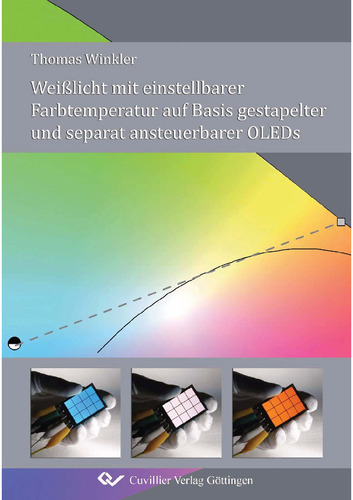
In an organic light-emitting diode (OLED), white light is generated by superimposing the emission spectra of different organic emitter materials. At least two complementary colours are required for this. Such a two-colour white exhibits a low colour rendering index (CRI) of <70. By using several colours, however, a CRI of >90 can theoretically be achieved. This very good colour rendering, together with the areal light emission, makes OLED technology attractive both for room lighting and for special lighting purposes, such as medical examination lamps. In this field of application, an additionally adjustable colour temperature along the Planckian locus during operation of the luminaire is required. The OLED light sources currently available, however, do not yet offer this possibility.
The present work therefore presents a concept for the realisation of colour-tunable white-light OLEDs for room lighting and medical lighting purposes. By vertically stacking two OLED structures with a contactable intermediate layer (centre electrode), separate driving of the individual OLEDs and thus variation of the intensity of specific spectral components within the overall spectrum is made possible. For a tangential approximation to the Planckian locus, the two complementary colours orange and blue are required. Therefore, OLED structures based on phosphorescent red and yellow emitter materials as well as their combination into a highly efficient orange-emitting OLED are first presented. Furthermore, an efficient blue-emitting OLED based on a fluorescent emitter material is presented.
The centre electrode is of particular importance in the realisation of a stacked, colour-tunable white-light OLED. It must not only be transparent and conductive; at the same time, non-destructive deposition of the electrode material onto the organic layers must be ensured. Therefore, thin (semi)transparent aluminium and silver films as well as transparent indium tin oxide (ITO) and zinc tin oxide (ZTO) films are investigated in detail with respect to their optical, electrical and structural properties. Furthermore, within the framework of these investigations, a highly conductive and transparent multilayer electrode based on ZTO/Ag/ZTO (ZAZ) is developed. Using a top-emitting OLED with a bifunctional outcoupling layer, a thin aluminium layer is presented as an efficient top electrode. An efficient transparent OLED is realised through the use of the ZAZ electrode. Finally, on the basis of the knowledge gained, stacked colour-tunable white-light OLEDs are demonstrated which exhibit a high CRI of 86 and whose colour temperature is continuously adjustable along the Planckian locus from 4000 K to 5000 K. The active area of these devices of 1 cm² is finally scaled up to a size of 11 cm².
| ISBN-13 (Printausgabe) | 3954041073 |
| ISBN-13 (Hard Copy) | 9783954041077 |
| ISBN-13 (eBook) | 9783736941076 |
| Final Book Format | A5 |
| Language | German |
| Page Number | 160 |
| Lamination of Cover | matt |
| Edition | 1 Aufl. |
| Volume | 0 |
| Publication Place | Göttingen |
| Place of Dissertation | Braunschweig |
| Publication Date | 2012-05-11 |
| General Categorization | Dissertation |
| Departments |
Physics
Electrical engineering |
| Keywords | Condensed matter physics (including solid state physics, optics) |


