
Cuvillier Verlag GmbH



| Departments | |
|---|---|
| Book Series (99) |
1415
|
| Nachhaltigkeit |
3
|
| Gesundheitswesen |
3
|
| Humanities |
2413
|
| Natural Sciences |
5430
|
| Engineering |
1822
|
| Engineering | 292 |
| Mechanical and process engineering | 873 |
| Electrical engineering | 700 |
| Mining and metallurgy | 30 |
| Architecture and civil engineering | 76 |
| Common |
97
|
|
Leitlinien Unfallchirurgie
5. Auflage bestellen |
|
Advanced Search
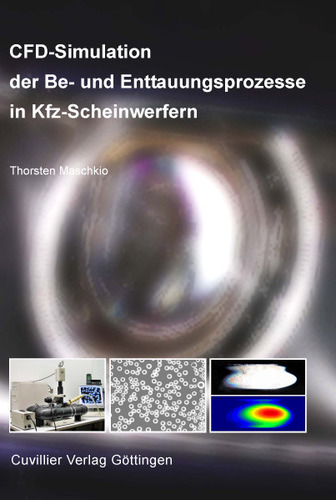
CFD-Simulation der Be- und Enttauungsprozesse in Kfz-Scheinwerfern (English shop)
Thorsten Maschkio (Author)Preview
Table of Contents, Datei (21 KB)
Extract, Datei (350 KB)
Increasingly short development times require detailed system testing to be shifted to an early phase of product development. Since experimental methods cannot be applied at this point due to the lack of prototypes, simulation methods based on virtual prototypes are being used more and more.
Such simulation methods are also desirable for analysing the fogging and defogging behaviour of headlamps. Fogging refers to the condensation of water in the visible areas of a headlamp and is regarded by customers as a quality deficit.
The aim of this work is to develop and validate a simulation method for analysing these processes and to demonstrate its possible applications. To this end, the first part of the work provides the mathematical description of the fogging and defogging processes, which are primarily influenced by heat and mass transport mechanisms. Many of the relevant equations are already contained in commercial CFD simulation tools, so that the use of such tools not only offers an effective and robust solution of the equations but also provides access to additional features such as pre- and post-processing. Equations not yet included must be integrated into the computational procedure.
Before the simulation method can be used in the development process of new headlamps, its validity must be examined within the scope of validation. For this purpose, fogging and defogging processes were generated under defined conditions using an experimental set-up and documented with suitable measurement technology. These processes were subsequently reproduced in simulations, whereby a high level of agreement between measurement and simulation results was shown.
The application of the simulation methodology in the development process of new headlamps enables not only the localisation of the areas critical to fogging but also the assessment of measures aimed at reducing the fogging problem.
| ISBN-13 (Printausgabe) | 3867271984 |
| ISBN-13 (Hard Copy) | 9783867271981 |
| ISBN-13 (eBook) | 9783736921986 |
| Final Book Format | A5 |
| Language | German |
| Page Number | 180 |
| Edition | 1 |
| Volume | 0 |
| Publication Place | Göttingen |
| Place of Dissertation | Paderborn |
| Publication Date | 2007-03-21 |
| General Categorization | Dissertation |
| Departments |
Engineering
|


