
Cuvillier Verlag GmbH



| Departments | |
|---|---|
| Book Series (99) |
1418
|
| Nachhaltigkeit |
3
|
| Gesundheitswesen |
3
|
| Humanities |
2418
|
| Natural Sciences |
5433
|
| Engineering |
1825
|
| Engineering | 292 |
| Mechanical and process engineering | 875 |
| Electrical engineering | 701 |
| Mining and metallurgy | 30 |
| Architecture and civil engineering | 76 |
| Common |
97
|
|
Leitlinien Unfallchirurgie
5. Auflage bestellen |
|
Advanced Search
Benzindirekteinspritzung (English shop)
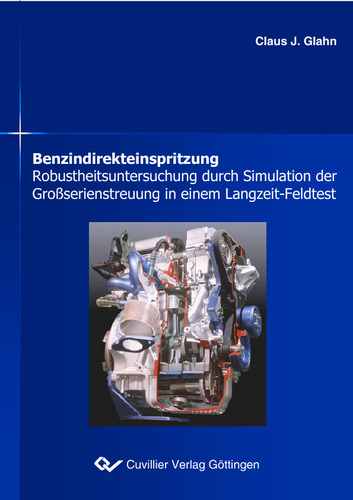
Robustheitsuntersuchung durch Simulation der Großserienstreuung in einem Langzeit-Feldtest
Claus Jürgen Glahn (Author)Preview
Table of Contents, Datei (23 KB)
Preface, Datei (30 KB)
Extract, Datei (210 KB)
Under the ACEA agreement, every automobile manufacturer has committed itself to reducing the CO2 emissions of its own total vehicle fleet, measured in the European test cycle NEDC, to 140 g/km by 2008 and to 120 g/km by 2012. For the spark-ignition engine this corresponds to a fuel consumption of 5.9 and 5.0 l/100km respectively, and for the diesel engine 5.3 and 4.5 l/100km respectively.
Gasoline direct injection (GDI) represents a promising approach to reducing fuel consumption. With this technology, in part-load operation the load is controlled in the so-called stratified mode via the quantity of fuel injected under high pressure during the compression stroke at a constant intake air mass. This minimises the throttling losses during the gas exchange. An inhomogeneous mixture is present in the combustion chamber, with an ignitable region at the spark plug and leaning towards the combustion chamber walls, whereby the thermal efficiency rises as a result of the lower wall heat losses. Towards higher loads, the control switches to conventional quantity control, in which the load is set via the mixture quantity using the throttle valve with a homogeneous mixture. Here this combustion process shows only a slight advantage, which is attributable to the cooling effect of the fuel that only evaporates in the combustion chamber and the resulting lower knock sensitivity. This permits the implementation of a higher compression ratio, whereby the thermal efficiency rises.
Although gasoline direct injection was already in use at Mercedes Benz and Ford in the 1950s, this technology, in conjunction with stratified-charge operation and the very stringent modern exhaust emissions legislation, places new demands on the fuel and exhaust systems.
Following a presentation of the fundamentals of gasoline direct injection, this work deals with the elaboration and implementation of a long-term fleet trial with regard to functional robustness and the influence of production tolerances, with particular attention to fuel consumption, exhaust emissions, maintenance requirements and customer acceptance.
To carry out the trial, 47 vehicles with 3-cylinder GDI spark-ignition engines were built and operated for 24 months by selected customers. The influence of large-scale production tolerances was simulated by deliberately adjusting system parameters selected during the elaboration of the test plan.
The work presents the potential of gasoline direct injection and illustrates, according to the current state of the art, its problems, which lie in compliance with exhaust emission limits and in the robustness of the exhaust system, as well as in the excessively high fuel consumption in real-world operation. Although this lies below the values of comparable conventional spark-ignition engines, it by no means yet exploits the theoretical potential of the combustion process.
The work concludes with an outlook on developments in the near future in the field of gasoline direct injection. These lie in the spray-guided combustion process in conjunction with exhaust gas turbocharging.
| ISBN-13 (Printausgabe) | 3867270392 |
| ISBN-13 (Hard Copy) | 9783867270397 |
| ISBN-13 (eBook) | 9783736920392 |
| Language | German |
| Page Number | 126 |
| Edition | 1 |
| Volume | 0 |
| Publication Place | Göttingen |
| Place of Dissertation | Duisburg-Essen |
| Publication Date | 2006-10-26 |
| General Categorization | Dissertation |
| Departments |
Mechanical and process engineering
|


