
Cuvillier Verlag GmbH



| Departments | |
|---|---|
| Book Series (99) |
1415
|
| Nachhaltigkeit |
3
|
| Gesundheitswesen |
3
|
| Humanities |
2410
|
| Natural Sciences |
5428
|
| Mathematics | 229 |
| Informatics | 320 |
| Physics | 982 |
| Chemistry | 1371 |
| Geosciences | 131 |
| Human medicine | 246 |
| Stomatology | 10 |
| Veterinary medicine | 112 |
| Pharmacy | 147 |
| Biology | 837 |
| Biochemistry, molecular biology, gene technology | 121 |
| Biophysics | 25 |
| Domestic and nutritional science | 45 |
| Agricultural science | 1005 |
| Forest science | 201 |
| Horticultural science | 20 |
| Environmental research, ecology and landscape conservation | 148 |
| Engineering |
1820
|
| Common |
97
|
|
Leitlinien Unfallchirurgie
5. Auflage bestellen |
|
Advanced Search
Dynamics of Solubilisation Processes in Amphiphilic Systems Studied by Highly Time-Resolved Stopped-Flow Experiments (English shop)
Anina Barth (Author)Preview
Table of Contents, Datei (37 KB)
Extract, Datei (370 KB)
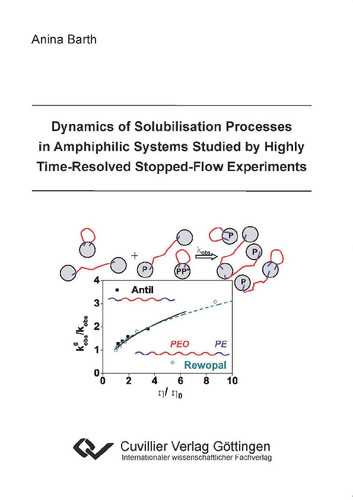
This work investigates solubilisation dynamics in ternary and quaternary surfactant systems. Microemulsions composed of the zwitterionic tetradecyldimethylamine oxide or the nonionic pentaethylene glycol monododecyl ether were used to study the oil exchange kinetics between these microemulsion droplets. The stopped-flow method – in which identical volumes of two solutions are mixed very rapidly and the properties of the mixture can be examined as a function of time – was employed for these investigations. Complementary detection methods (turbidity, fluorescence and small-angle X-ray scattering) served to study the kinetics of oil exchange and of the formation of amphiphilic structures. For this purpose, a pyrene stearyl ester was synthesised and used as a fluorescent dye, which made it possible to obtain a comprehensive overview of the solubilisation kinetics while the molecular composition of the microemulsions was systematically varied. Fluorescence measurements showed that it is not the bending rigidity but the curvature of the surfactant film that is the decisive factor for oil exchange in a ternary, nonionic microemulsion system. At the same bending rigidity, oil exchange proceeds more slowly the smaller the aggregates are. By adding small amounts of charge and amphiphilic polymer, and through the resulting increase in electrostatic and steric repulsion, the rate of the coalescence process was deliberately slowed down. At the same time, the activation energy for this step increased owing to the additional hindrance. A further aim was to investigate the structural transition from micelle/microemulsion to vesicles. The spontaneous formation of the vesicles is influenced by the composition of the sample and therefore depends crucially on their formation process. The rate of formation is slower the greater the difference in composition between the initial and final states.
| ISBN-13 (Printausgabe) | 3869558741 |
| ISBN-13 (Hard Copy) | 9783869558745 |
| ISBN-13 (eBook) | 9783736938748 |
| Final Book Format | A5 |
| Language | English |
| Page Number | 182 |
| Lamination of Cover | matt |
| Edition | 1 Aufl. |
| Volume | 0 |
| Publication Place | Göttingen |
| Place of Dissertation | Universität Berlin |
| Publication Date | 2011-09-22 |
| General Categorization | Dissertation |
| Departments |
Chemistry
|


