
Cuvillier Verlag GmbH



| Departments | |
|---|---|
| Book Series (99) |
1415
|
| Nachhaltigkeit |
3
|
| Gesundheitswesen |
3
|
| Humanities |
2411
|
| Natural Sciences |
5429
|
| Mathematics | 230 |
| Informatics | 320 |
| Physics | 982 |
| Chemistry | 1371 |
| Geosciences | 131 |
| Human medicine | 246 |
| Stomatology | 10 |
| Veterinary medicine | 112 |
| Pharmacy | 147 |
| Biology | 837 |
| Biochemistry, molecular biology, gene technology | 121 |
| Biophysics | 25 |
| Domestic and nutritional science | 45 |
| Agricultural science | 1005 |
| Forest science | 201 |
| Horticultural science | 20 |
| Environmental research, ecology and landscape conservation | 148 |
| Engineering |
1821
|
| Common |
97
|
|
Leitlinien Unfallchirurgie
5. Auflage bestellen |
|
Advanced Search
Untersuchungen zur Feldemission in supraleitenden Beschleunigungsstrukturen des S-DALINAC mit Hilfe der Röntgenspektroskopie und Vergleich mit herkömmlichen Methoden (English shop)
Wolfgang Bayer (Author)Preview
Table of Contents, Datei (60 KB)
Extract, Datei (190 KB)
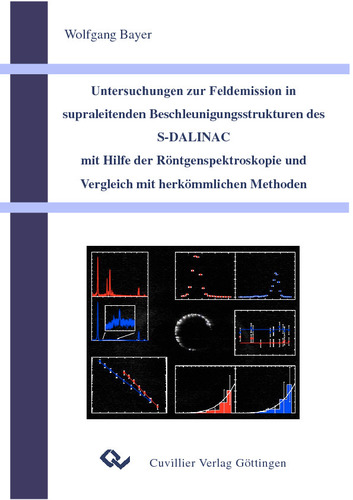
This thesis investigates field emission in two superconducting accelerating structures of the S–DALINAC injector, which was accompanied by the emission of light in the visible range. For the first time in this context, the emission of characteristic X-rays could also be observed by using an X-ray detector inside the beam vacuum. Field emission, light emission and the emission of characteristic X-rays were studied by various methods. First, the regions were determined in which the field-emitted electrons impinged on the wall of the structure, and those in which the light-emitting centres, arranged along circles, were located. Since electrons emit bremsstrahlung when interacting with matter, both the dose rate — using commercially available dose rate meters — and the bremsstrahlung intensity — using a high-purity germanium detector — were measured along the injector in order to determine the region in which the electrons hit the wall. The light-emitting centres were observed with a motor-controlled CCD camera and their position within the structure was localised by means of a specially developed method for distance determination. It turned out that the regions of maximum dose rate and bremsstrahlung emission as well as those of the light emitters all coincide. A Fowler–Nordheim characteristic could be demonstrated for the dose rate, the bremsstrahlung intensity and, for the first time, also for the intensity of the characteristic X-rays. In particular, the method of X-ray spectroscopy proved suitable for a reliable determination of the field enhancement factor. In addition to the observation of the light-emitting centres with a CCD camera, the intensity and the spectral distribution of the light were investigated using a photomultiplier and a set of coloured glass filters. These measurements indicated that dust particles located on an iris aperture inside the structure were presumably heated to about 1200 K by dielectric losses of the radio-frequency power coupled into the structure and were thus excited to emit light. The trajectory tracking calculations carried out for one structure and all other results suggest that these glowing particles are also likely to be the sources of the electron emission. After chemical cleaning and baking of one structure at about 1170 K, no field emission and none of the accompanying emission of light and X-rays was detected in this structure up to an accelerating field strength of 6.5 MV/m.
| ISBN-13 (Printausgabe) | 386537641X |
| ISBN-13 (Hard Copy) | 9783865376411 |
| ISBN-13 (eBook) | 9783736916418 |
| Language | German |
| Page Number | 130 |
| Edition | 1 Aufl. |
| Volume | 0 |
| Publication Place | Göttingen |
| Place of Dissertation | Darmstadt |
| Publication Date | 2005-10-20 |
| General Categorization | Dissertation |
| Departments |
Physics
|


