
Cuvillier Verlag GmbH



| Departments | |
|---|---|
| Book Series (99) |
1415
|
| Nachhaltigkeit |
3
|
| Gesundheitswesen |
3
|
| Humanities |
2411
|
| Medienwissenschaften | 17 |
| Theology | 57 |
| Philosophy | 103 |
| Law | 430 |
| Economics | 863 |
| Social sciences | 423 |
| Sports science | 48 |
| Psychology | 233 |
| Educational science | 190 |
| History | 194 |
| Art | 111 |
| Cultural studies | 167 |
| Literary studies | 118 |
| Linguistics | 91 |
| Natural Sciences |
5429
|
| Engineering |
1821
|
| Common |
97
|
|
Leitlinien Unfallchirurgie
5. Auflage bestellen |
|
Advanced Search
Die Bewertung von Patenten (English shop)
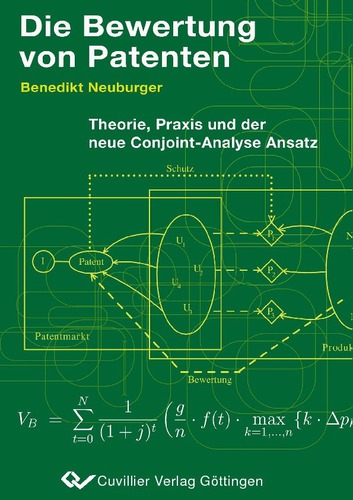
Theorie, Praxis und der neue Conjoint-Analyse Ansatz
Benedikt Neuburger (Author)Preview
Table of Contents, Datei (58 KB)
Extract, Datei (120 KB)
The first part of this study clarifies two aspects: on the one hand, numerous economic and legal occasions arise in everyday business practice that require a patent valuation to be carried out. On the other hand, the known valuation methods exhibit shortcomings from both a theoretical and a practical perspective. The second part of this study, Chapter 5, presents a patent valuation method hitherto unknown in the literature, based on conjoint analysis. For a patent to be valued, and in view of the relevant prior art, the technical features are determined in which the embodiments protected by the patent differ from the prior art. Within the framework of a conjoint analysis, to be conducted with a group of persons intended to represent a representative image of the relevant demand market for the product associated with the patent, it is first determined what utility the potential purchasers assign to the patent-protected embodiments. On the basis of the results of the conjoint analysis, these individual utilities are converted into individual reservation prices for the protected embodiments and then aggregated into a common price-response function. On the basis of the price-revenue function derivable from this and a suitable cost function, a price-profit function is calculated and maximised. The maximum attainable profit calculated in this way, attributable to the commercialisation or use of the technical teaching of the patent, enters into the patent value as a key variable. Other variables influencing the patent value, such as the risks associated with realising the maximum profit, are likewise taken into account. The valuation method presented in this study is not applicable to all patents. Where it is applied, the valuation costs are relatively high. Nevertheless, the present method offers a substantial advantage over known methods: the value at the time of valuation of those patents whose value is essentially founded on the exclusive right to use certain technical features can be calculated with high accuracy, since both the technical and legal scope of protection of the patent and the demand behaviour with regard to the protected technical features are analysed precisely. The method can be applied to patents or patent applications of any age. The fully executed valuation of a patent towards the end of the study illustrates the essential steps of the method using an example patent and demonstrates the practical applicability of the valuation procedure presented.
| ISBN-13 (Printausgabe) | 3865375472 |
| ISBN-13 (Hard Copy) | 9783865375476 |
| ISBN-13 (eBook) | 9783736915473 |
| Language | German |
| Page Number | 294 |
| Edition | 0 |
| Volume | 0 |
| Publication Place | Göttingen |
| Place of Dissertation | München |
| Publication Date | 2005-08-19 |
| General Categorization | Dissertation |
| Departments |
Law
Economics |


