
Cuvillier Verlag GmbH



| Departments | |
|---|---|
| Book Series (99) |
1415
|
| Nachhaltigkeit |
3
|
| Gesundheitswesen |
3
|
| Humanities |
2411
|
| Natural Sciences |
5429
|
| Mathematics | 230 |
| Informatics | 320 |
| Physics | 982 |
| Chemistry | 1371 |
| Geosciences | 131 |
| Human medicine | 246 |
| Stomatology | 10 |
| Veterinary medicine | 112 |
| Pharmacy | 147 |
| Biology | 837 |
| Biochemistry, molecular biology, gene technology | 121 |
| Biophysics | 25 |
| Domestic and nutritional science | 45 |
| Agricultural science | 1005 |
| Forest science | 201 |
| Horticultural science | 20 |
| Environmental research, ecology and landscape conservation | 148 |
| Engineering |
1821
|
| Common |
97
|
|
Leitlinien Unfallchirurgie
5. Auflage bestellen |
|
Advanced Search
Orodispersible Minitabletten (English shop)
Entwicklung und Charakterisierung einer neuen festen Darreichungsform für die Pädiatrie
Ines Stoltenberg (Author)Preview
Table of Contents, Datei (50 KB)
Extract, Datei (150 KB)
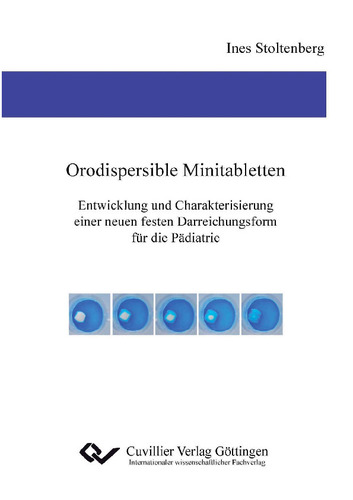
Since the entry into force of the EU Regulation on medicinal products for paediatric use, there has been an increased need for child-appropriate dosage forms. The paradigm shift initiated in recent years away from liquid towards solid oral dosage forms requires the development of solid dosage forms that can already be administered to infants and toddlers. Therefore, the present work introduces the orodispersible minitablet (ODMT) as a new approach, combining orodispersible tablets with minitablets.
For the first time, drug-free ODMTs based on the ready-to-use excipient Ludiflash® could be developed with a sufficient crushing force of 8 N and, at the same time, a short wetting time of _ 3 s. In addition, ODMTs containing Ludiflash® and hydrochlorothiazide in child-appropriate doses could be manufactured. These preparations showed a disintegration-dependent drug release, which could be demonstrated with the aid of a self-developed dissolution apparatus.
The comparison of five commercial ready-to-use excipients (Ludiflash®, Pearlitol® Flash, Parteck® ODT, Prosolv® ODT and Pharmaburst® 500), carried out for the first time, revealed manifold differences between the ODMTs with regard to disintegration times and mechanical properties. The subsequently manufactured ODMTs containing hydrochlorothiazide complied with the requirements of the European Pharmacopoeia regarding the uniformity of content of single-dose preparations. The drug content remained constant over a storage period of six months under stress conditions. Moreover, with four out of five excipients, ODMTs with complete drug release _ 15 minutes could be developed.
The excipient products used were compared with physical mixtures of the individual components and with dry granules of the same composition. Overall, comparable results were obtained, so that no advantage of the ready-to-use excipients over the physical mixtures could be determined within the scope of the investigations carried out.
Furthermore, ODMTs containing zinc sulfate as the drug substance were developed and characterised for the first time. The influence of the combination of zinc sulfate and excipient on the disintegration behaviour of tablets was investigated in more detail. In addition, a successful concept for taste masking of zinc sulfate in ODMTs could be developed. Within the framework of a taste characterisation by adult subjects, conclusions regarding taste masking could be drawn. The results of the measurements with an electronic tongue correlated well with the results of the panel of subjects.
Moreover, a comparison of different in vitro methods for investigating the disintegration of ODMTs was carried out. The results were compared with the results of an in vivo test. The most important characteristics of a suitable method for investigating disintegration could be defined. The Simulated Wetting Test as well as the disintegration tests using the Electro Force® instrument and the rotating punch proved to be the most suitable methods.
In summary, the development of orodispersible minitablets containing hydrochlorothiazide and taste-masked zinc sulfate was successful. Thus, a new technological platform is available that enables the manufacture of flexibly dosable solid oral dosage forms using conventional tablet presses. Children in particular can benefit from this new development. An application of the ODMTs in children < 6 months could be possible on the basis of the properties investigated, but would have to be verified by means of acceptability studies. In addition, an evaluation of various ready-to-use excipients could be carried out, and new specific analytical methods for characterising the disintegration properties of the preparations could be developed.
| ISBN-13 (Printausgabe) | 3954040700 |
| ISBN-13 (Hard Copy) | 9783954040704 |
| ISBN-13 (eBook) | 9783736940703 |
| Final Book Format | A5 |
| Language | German |
| Page Number | 130 |
| Lamination of Cover | matt |
| Edition | 1 Aufl. |
| Volume | 0 |
| Publication Place | Göttingen |
| Place of Dissertation | Düsseldorf |
| Publication Date | 2012-04-27 |
| General Categorization | Dissertation |
| Departments |
Pharmacy
|
| Keywords | Custom medicines, orodispersible tablets, mini-tablets, disintegration test, pharmaceutical technology |


