
Cuvillier Verlag GmbH



| Departments | |
|---|---|
| Book Series (99) |
1415
|
| Nachhaltigkeit |
3
|
| Gesundheitswesen |
3
|
| Humanities |
2410
|
| Natural Sciences |
5428
|
| Mathematics | 229 |
| Informatics | 320 |
| Physics | 982 |
| Chemistry | 1371 |
| Geosciences | 131 |
| Human medicine | 246 |
| Stomatology | 10 |
| Veterinary medicine | 112 |
| Pharmacy | 147 |
| Biology | 837 |
| Biochemistry, molecular biology, gene technology | 121 |
| Biophysics | 25 |
| Domestic and nutritional science | 45 |
| Agricultural science | 1005 |
| Forest science | 201 |
| Horticultural science | 20 |
| Environmental research, ecology and landscape conservation | 148 |
| Engineering |
1821
|
| Common |
97
|
|
Leitlinien Unfallchirurgie
5. Auflage bestellen |
|
Advanced Search
Rasterkraftmikroskopie und -spektroskopie am magnetischen Molekül Co-Salen (English shop)
Knud Lämmle (Author)Preview
Table of Contents, Datei (54 KB)
Extract, Datei (160 KB)
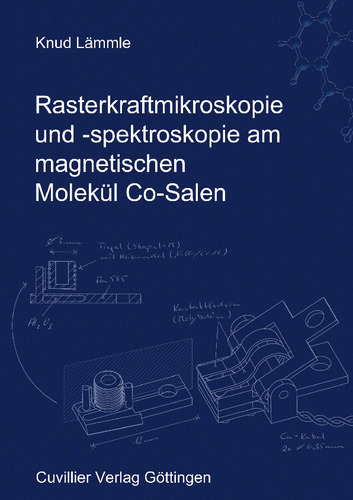
This work deals with atomic force microscopy and spectroscopy experiments on the magnetic molecule Co-salen. It traces the development of these experiments, beginning with the design and construction of preparation facilities, through the measurements, up to comparisons with calculations.
The first two chapters present the physical and measurement-related fundamentals required for the experiments. Subsequently, the instrumentation used is described. Here, in particular, those parts that were designed specifically for the experiments presented here and that extend the existing instrumentation are described in detail. Besides a new sample holder design and a device for cleaving insulating single crystals, this concerns above all a novel evaporator. This evaporator can be used directly in an atomic force microscope operated at cryogenic temperatures in order to deposit molecules onto cold substrates. The operating principle of the evaporator allows retrofitting without modifications to sensitive parts of the microscope and is, moreover, easily adaptable to other setups. In the course of this work, a new technique for producing an ultra-high-vacuum-compatible metal-ceramic joint was developed.
In the measurements presented after the description of the sample preparation, not only the orientation but, for the first time, also the adsorption site of an organic molecule such as Co-salen on a (bulk) insulator is determined. For this purpose, the substrate was resolved atomically in parallel with the imaging of a molecule. The final chapter addresses the problem that, in the case of substrates consisting of several elements, it is generally unclear which signals in the measurement data represent the individual elements. To answer this question, calculations were carried out at University College London which, together with the spectroscopy data shown here, permit an unambiguous and generally valid assignment for the combination of ionic substrates and metallic tips.
| ISBN-13 (Printausgabe) | 3869557931 |
| ISBN-13 (Hard Copy) | 9783869557939 |
| ISBN-13 (eBook) | 9783736937932 |
| Final Book Format | A5 |
| Language | German |
| Page Number | 150 |
| Lamination of Cover | matt |
| Edition | 1 Aufl. |
| Volume | 0 |
| Publication Place | Göttingen |
| Place of Dissertation | Universität Hamburg |
| Publication Date | 2011-06-21 |
| General Categorization | Dissertation |
| Departments |
Physics
|
| Keywords | Atomic force microscopy, Co-salen, magnetic molecules |


