
Cuvillier Verlag GmbH



| Departments | |
|---|---|
| Book Series (99) |
1415
|
| Nachhaltigkeit |
3
|
| Gesundheitswesen |
3
|
| Humanities |
2415
|
| Medienwissenschaften | 17 |
| Theology | 57 |
| Philosophy | 103 |
| Law | 430 |
| Economics | 866 |
| Social sciences | 423 |
| Sports science | 48 |
| Psychology | 233 |
| Educational science | 190 |
| History | 194 |
| Art | 111 |
| Cultural studies | 168 |
| Literary studies | 119 |
| Linguistics | 91 |
| Natural Sciences |
5432
|
| Engineering |
1822
|
| Common |
97
|
|
Leitlinien Unfallchirurgie
5. Auflage bestellen |
|
Advanced Search
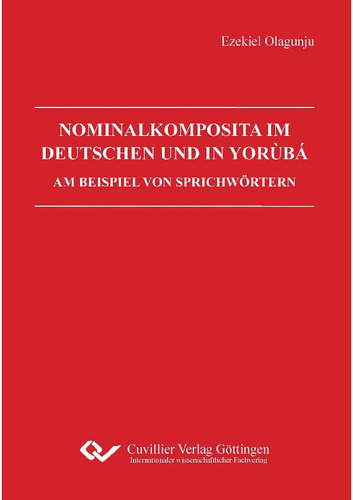
Nominalkompisita im Deutschen und in Yorùbá (English shop)
Am Beispiel von Sprichwörtern
Ezekiel Oludare Olagunju (Author)Preview
Table of Contents, Datei (35 KB)
Extract, Datei (73 KB)
The subject of this study is the examination of compound formation in German and in Yorùbá proverbs with regard to the transfer process of Yorùbá nominal compounds into German.
Despite the fact that the nominal compounds of German and of the Yorùbá language display a binary structure, they show far-reaching differences in their formal structure and also in their frequency in proverbs. The analysis has demonstrated that the Yorùbá language has no nominal compounds with a linking element. Moreover, nominal compounds with a verbal first element are very widespread in German, but not in Yorùbá.
The phonetic principles of Yorùbá compounds, vowel elision and assimilation, do not appear in German nominal compounds. For German, assimilation and vowel elision are entirely irrelevant.
In German nominal compounds there is the sequence: determinans – determinatum. In Yorùbá, by contrast, there is the sequence: determinatum – determinans. Problems in rendering Yorùbá nominal compounds into German arise above all when the relationship between determinatum and determinans is not observed and when the cultural specifics and differentiations of the source-language text/target text are not taken into account. In order to be able to carry out a translation, the translator requires linguistic knowledge of the formation conventions in both Yorùbá and German.
A comparative analysis of the two languages clearly shows that the German language has more morphological features than the Yorùbá language, but on closer examination of the proverbs of the two languages studied, I find that Yorùbá proverbs display more nominal compounds than German proverbs.
| ISBN-13 (Printausgabe) | 3869558733 |
| ISBN-13 (Hard Copy) | 9783869558738 |
| ISBN-13 (eBook) | 9783736938731 |
| Final Book Format | A5 |
| Language | German |
| Page Number | 92 |
| Lamination of Cover | glossy |
| Edition | 1 Aufl. |
| Volume | 0 |
| Publication Place | Göttingen |
| Publication Date | 2012-04-17 |
| General Categorization | Non-Fiction |
| Departments |
Linguistics
|
| Keywords | Nominal compounds, proverbs, Yoruba proverbs, German proverbs, compounds, determinative compounds, copulative compounds, exocentric compounds, linking element, Yoruba compounds, vowel elision, assimilation |


