
Cuvillier Verlag GmbH



| Departments | |
|---|---|
| Book Series (99) |
1415
|
| Nachhaltigkeit |
3
|
| Gesundheitswesen |
3
|
| Humanities |
2412
|
| Natural Sciences |
5430
|
| Mathematics | 230 |
| Informatics | 320 |
| Physics | 982 |
| Chemistry | 1371 |
| Geosciences | 131 |
| Human medicine | 246 |
| Stomatology | 10 |
| Veterinary medicine | 112 |
| Pharmacy | 147 |
| Biology | 837 |
| Biochemistry, molecular biology, gene technology | 121 |
| Biophysics | 25 |
| Domestic and nutritional science | 45 |
| Agricultural science | 1006 |
| Forest science | 201 |
| Horticultural science | 20 |
| Environmental research, ecology and landscape conservation | 149 |
| Engineering |
1821
|
| Common |
97
|
|
Leitlinien Unfallchirurgie
5. Auflage bestellen |
|
Advanced Search
Ernte und Silierung pflanzlicher Substrate für die Biomethanisierung - Prozessgrundlagen und Bewertung (English shop)
Christiane Herrmann (Author)Preview
Table of Contents, Datei (34 KB)
Extract, Datei (97 KB)
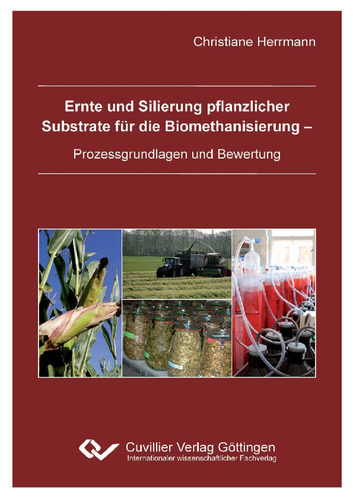
In recent years, biogas production has gained considerable importance as a process for the sustainable generation of renewable energy from biomass. In addition to organic residues, the use of energy crops with high methane formation potentials has become established as a substrate for biogas production. In order to effectively exploit the high energetic potential of these substrates, an optimal design of the entire supply chain of the energy crops should be sought. This includes in particular the harvesting and conservation of the plant material.
The aim of the dissertation is to develop fundamental knowledge on the influence of various parameters in the harvesting and ensiling of whole plants on biomethanation. In doing so, optimisation potentials are to be identified and recommendations for an optimal design of the supply chain are to be given. The second part of the present work focuses on the parameter chop length. The additional effort and benefit of a very short chop length setting on the forage harvester is to be compared with a length setting customary in practice. To address this topic, systematic investigations were carried out on a laboratory scale. Model ensiling trials and batch fermentation tests were used as established methods. The evaluation of very short length settings on the forage harvester was carried out by means of a comparative calculation of energy and greenhouse gas balances as well as costs and revenues, based on data collected during harvests in practice and a model calculation for capacity assessment.
The results of the laboratory experiments show that, above all, the formation of acetic acid and alcohols during ensiling as well as the addition of biological silage additives and a longer storage duration have a positive effect on the methane yield in relation to the organic dry matter supplied. However, taking into account the mass losses that occur during ensiling due to fermentation processes, no significant increase in methane formation is to be expected from these ensiling parameters. Higher methane yields, when the ensiling losses are taken into account, can instead be achieved by setting a shorter chop length at harvest. In the range of mean particle lengths between 33 and 6 mm, a maximum increase in methane yield of 10 to 13 % can be achieved. For practical application, short theoretical chop lengths of 7 to 8 mm are recommended. A further reduction of the theoretical chop length can lead to lower net energy production and to economic losses, although with the current state of knowledge this cannot be reliably estimated in advance. Further research is needed in this regard.
| ISBN-13 (Printausgabe) | 3869555351 |
| ISBN-13 (Hard Copy) | 9783869555355 |
| ISBN-13 (eBook) | 9783736935358 |
| Language | German |
| Page Number | 352 |
| Edition | 1 Aufl. |
| Volume | 0 |
| Publication Place | Göttingen |
| Place of Dissertation | Universität Berlin |
| Publication Date | 2010-10-29 |
| General Categorization | Dissertation |
| Departments |
Agricultural science
|
| Keywords | Biogas, energy crops, silage, preservation, chop length, methane yield |


