
Cuvillier Verlag GmbH



| Departments | |
|---|---|
| Book Series (99) |
1415
|
| Nachhaltigkeit |
3
|
| Gesundheitswesen |
3
|
| Humanities |
2410
|
| Natural Sciences |
5428
|
| Mathematics | 229 |
| Informatics | 320 |
| Physics | 982 |
| Chemistry | 1371 |
| Geosciences | 131 |
| Human medicine | 246 |
| Stomatology | 10 |
| Veterinary medicine | 112 |
| Pharmacy | 147 |
| Biology | 837 |
| Biochemistry, molecular biology, gene technology | 121 |
| Biophysics | 25 |
| Domestic and nutritional science | 45 |
| Agricultural science | 1005 |
| Forest science | 201 |
| Horticultural science | 20 |
| Environmental research, ecology and landscape conservation | 148 |
| Engineering |
1819
|
| Common |
97
|
|
Leitlinien Unfallchirurgie
5. Auflage bestellen |
|
Advanced Search
Solubility enhancement of poorly water-soluble drugs by solid dispersion (English shop)
a comparison of two manufacturing methods
Adela Kalivoda (Author)Preview
Extract, PDF (520 KB)
Table of Contents, PDF (130 KB)
Summary
Solid dispersions are a promising approach for controlled release drug delivery systems as both the bioavailability enhancement of poorly water-soluble drugs as well as the sustained release of water-soluble drugs are possible to optimize their in vivo performance.
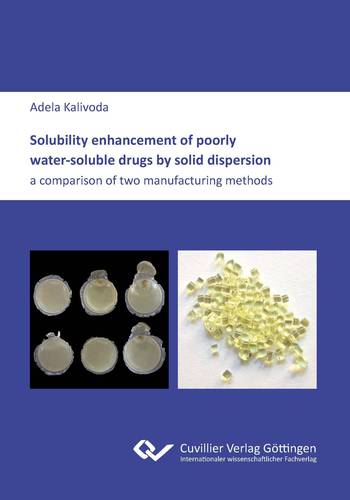
Different methods for the manufacture of solid dispersion systems have been introduced in literature. In the present work, two methods are compared: hot-melt extrusion and ultrasound-assisted compaction technique. Various carrier systems and drugs with different physicochemical properties are applied to investigate the feasibility of the technologies for pharmaceutical formulation. The formulations are compared to the corresponding untreated physical blends of the components regarding their solid state structure and dissolution behavior to assess the effect of the manufacturing technique.
Ultrasound-assisted compaction technique improves the initial dissolution rate of fenofibrate, a poorly water-soluble model drug. The crystalline API is partially converted into its amorphous state. As equivalent results can be achieved if the polymers are added directly to the dissolution medium, the dissolution enhancement is attributed to an improved wettability of the drug.
A statistical design of experiments is employed to investigate the effect of the process parameters on the results. Difficulties are encountered in the determination of process parameters which result in an optimal outcome. The process is very sensitive to the smallest changes of settings, for example of the position of the sonotrode. Additionally, the delivery of ultrasound energy is inhomogeneous. There is no or only insufficient user control of these parameters available. Furthermore, the duration of ultrasound energy delivery which is identified as a crucial parameter cannot be set by the user. The variable factors ultrasound energy, pressure of the lower piston and pressure of the upper piston affect the defined responses in the opposite direction. Hence, there are no settings which result in a satisfactory outcome. A strong influence of the material characteristics on the process is observed leading to a batch to batch variability.
Due to an insufficient reproducibility of results, the application of the technology cannot be recommended in its current state in the pharmaceutical formulation development and/or production. Improvements in homogeneity of energy delivery, process monitoring, user control and amount of leakage are mandatory for an acceptable performance and a future application in the pharmaceutical sector.
The polymers COP, HPMC and PVCL-PVAc-PEG are well suitable as carriers for hot-melt extruded formulations of fenofibrate. All three extrudates are amorphous one-phase systems with the drug molecularly dispersed in the polymer.
The enhancement of the initial dissolution rate and the maximum concentration level achieved are dependent on the applied carrier system. Supersaturation levels of up to 12.1 times are reached which are not stable due to recrystallization processes. The application of blends of polymers as carriers reduces the decrease rate after cmax. Because of water absorption and polymer relaxation, the overall dissolution performance decreases with increasing storage times which can be avoided through an optimization of the packaging.
If oxeglitazar is used as API, the initial dissolution rate of the extrudates is below that of the untreated drug, with the exception of the ternary blend of COP, HPMC and oxeglitazar which shows a substance-specific super-additive effect. In contrast to the other extrudates, the formulation of PVCL-PVAc-PEG and oxeglitazar does not form a molecularly dispersed solid solution of the drug in the carrier. Instead, an amorphous two-phase system is present. No changes are observed after storage, presumably due to higher glass transition temperatures of the hot-melt extruded systems which are considerably above those of the corresponding fenofibrate extrudates.
With felodipine as API, the dissolution profile is enhanced with COP as single carrier. If HPMC or PVCL-PVAc-PEG is used as single or additional polymeric carriers, the dissolution is equivalent (HPMC) or lower (PVCL-PVAc-PEG) than that of the pure drug although molecularly disperse systems are present in all cases.
Out of the two investigated methods only hot-melt extrusion is a suitable technology to manufacture solid dispersions with an improved dissolution behavior. The dissolution profile of the extrudates can be influenced by adding polymers with differing physicochemical characteristics. Predictions on the dissolution behavior of the extrudates with polymeric blends as carriers can be made if there is knowledge on the dissolution profiles of the corresponding single polymeric extrudates. Due to substance-specific effects, the results are not transferable from drug to drug. Even so, the data are promising as the release behavior of the manufactured extrudates can be easily modified and readily adapted to one’s needs.
Further research will have to be conducted to verify the concept and the relevance of the results in vivo.
Summary
Solid dispersions are a promising approach for the manufacture of drug delivery systems with controlled drug release, since they can both improve the bioavailability of poorly water-soluble drugs and retard the release of highly water-soluble drugs, thus optimizing their in vivo behavior.
Various manufacturing methods have been presented in the literature. In the present work, two technologies are compared with each other: hot-melt extrusion and ultrasound-assisted compaction (USAC). Different carrier systems and drugs with different physicochemical properties are investigated in order to examine the applicability in the pharmaceutical field. The structure of the manufactured systems and their dissolution behavior are compared with the physical blends of the components in order to determine the influence of the formulation.
By means of USAC, the initial dissolution rate of fenofibrate, a poorly water-soluble model drug, is improved. A partial conversion from the crystalline into the amorphous state occurs. Comparable results are achieved when the polymer is added to the dissolution medium; therefore, it is assumed that above all an improved wettability of the drug plays a role.
By means of a statistical design of experiments, the influence of the various process parameters is investigated. The setting of the process parameters in order to obtain an optimal result proves to be difficult. The process reacts extremely sensitively to the smallest changes, for example of the position of the sonotrode. In addition, the ultrasound energy is not transmitted homogeneously. Control of these parameters by the user is not possible or only insufficiently so. Likewise, the duration of the ultrasound application, which is essential for the process, cannot be set. The process parameters ultrasound energy, lower punch pressure and sonotrode pressure influence the responses in opposite directions. Therefore, there is no setting that delivers optimal results for all responses. In addition, the process depends strongly on the properties of the material used: the use of different polymer batches makes an adjustment of the process parameters necessary in order to obtain comparable results.
A sufficient reproducibility of the results for an application of this technology in formulation development or production is not given. A homogeneous supply of ultrasound energy as well as improvements in process monitoring, user control and a reduction of the amount of leaking material are absolutely necessary for an acceptable performance and a future application in the pharmaceutical field.
The polymers COP, HPMC, PVCL-PVAc-PEG are suitable for a dissolution enhancement of fenofibrate by means of hot-melt extrusion. One-phase, molecularly disperse solid solutions are present. Depending on the carrier substance, the initial dissolution rate is increased to a different extent, as is the maximum concentration of the drug in solution. A supersaturation of up to 12.1-fold is reached, which is not stable due to recrystallization processes. The use of polymeric blends reduces the rate of the concentration decline. The absorption of water and relaxation effects diminish the dissolution enhancement with increasing storage time; this development can be counteracted by an optimization of the packaging material.
If the likewise poorly water-soluble drug oxeglitazar is used, the initial dissolution rate of the extrudates is inferior to that of the pure drug, with the exception of the ternary blend of COP, HPMC and oxeglitazar, which shows a substance-specific super-additive effect. In contrast to the other formulations, PVCL-PVAc-PEG–oxeglitazar extrudates do not form a molecularly disperse solid solution, but an amorphous two-phase system. A change during the storage time is not observed, presumably due to the higher glass transition temperatures of these systems.
Only the dissolution profile of COP–felodipine extrudates is improved. Compared to the pure drug, the dissolution of the other extrudates is comparable (HPMC) or reduced (PVCL-PVAc-PEG), although molecularly disperse systems are present here as well.
Of the two technologies investigated, only hot-melt extrusion is suitable for manufacturing solid dispersions with an improved dissolution behavior. The dissolution profile of the extrudates can be optimized by the addition of polymers with different properties and can be predicted if the dissolution profile of the single-polymer extrudates is known. Due to substance-specific effects, the results are not transferable from drug to drug. Nevertheless, the findings of this work are promising, since it is shown that the dissolution profile of the extrudates can easily be influenced and adapted to specific requirements.
Further investigations are necessary in order to verify the concept and the relevance of the results in vivo.
| ISBN-13 (Hard Copy) | 9783954041411 |
| ISBN-13 (eBook) | 9783736941410 |
| Final Book Format | A5 |
| Language | English |
| Page Number | 198 |
| Lamination of Cover | matt |
| Edition | 1. Aufl. |
| Publication Place | Göttingen |
| Place of Dissertation | Göttingen |
| Publication Date | 2012-06-25 |
| General Categorization | Dissertation |
| Departments |
Pharmacy
|


