
Cuvillier Verlag GmbH



| Departments | |
|---|---|
| Book Series (99) |
1415
|
| Nachhaltigkeit |
3
|
| Gesundheitswesen |
3
|
| Humanities |
2410
|
| Natural Sciences |
5428
|
| Engineering |
1820
|
| Common |
97
|
| Common | 90 |
| Equestrian sports | 6 |
|
Leitlinien Unfallchirurgie
5. Auflage bestellen |
|
Advanced Search
Frau und Auto (Volume 9) (English shop)
Ergebnisse empirischer Untersuchungen aus 2005 und 2010
Doris Kortus-Schultes (Author)Wolfgang Laufner (Author)
Preview
Extract, PDF (49 KB)
Table of Contents, PDF (20 KB)
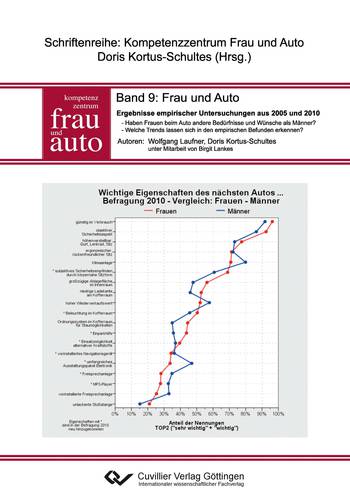
Women currently own around 36% of privately registered passenger cars. Around 45% of women between the ages of 18 and 75 are car owners. The proportion of women holding a driving licence is – depending on the age group – up to 95%. Whichever of these three statistical indicators one takes, all three have risen steadily in recent decades. The car has long ceased to be a male domain. Is this also given due consideration by the automotive industry?
The Kompetenzzentrum Frau und Auto at the Hochschule Niederrhein has been studying women as “car consumers” for almost 10 years. What needs, requirements and wishes do women have with regard to their cars? Are there differences here compared with men? Are there trends? To answer these and other questions, more than 4,200 women and men were surveyed in two waves of data collection in 2005 and 2010 as part of an empirical trend study. For only a statistical comparison reveals the differences.
Initial results, which are presented in this study, show that for numerous features “all around the car”, women’s wishes and also their demands (expressed by the ratings of importance) differ in some cases quite considerably from those of men. This also applies to satisfaction with these features. However, the analyses show that the results depend not only on gender but often much more strongly on the age and thus also on the life situation of the respondents. For this reason, the results in this study are mostly analysed as a function of gender and age.
The data from two surveys conducted five years apart make it possible to attempt certain statements about trends. It emerges that demands regarding many features have increased, but so has satisfaction with them. This finding applies more strongly to women than to men. This could be an indication that car manufacturers, but especially car dealerships and car repair shops, can record certain progress in addressing their target groups.
| ISBN-13 (Hard Copy) | 9783954041206 |
| ISBN-13 (eBook) | 9783736941205 |
| Final Book Format | A4 |
| Language | German |
| Page Number | 100 |
| Lamination of Cover | matt |
| Edition | 1 Aufl. |
| Book Series | Kompetenzzentrum Frau und Auto |
| Volume | 9 |
| Publication Place | Göttingen |
| Publication Date | 2012-07-09 |
| General Categorization | Non-Fiction |
| Departments |
Common
Business economics |
| Keywords | Women and cars, car purchase, Schriftenreihe Kompetenzzentrum Frau und Auto, market research in the automotive industry, market segment women, market segment female drivers, market segmentation by gender and age, vehicle purchase, car dealers, car dealerships, car repair shop, car brands favoured by women, car design preferred by women, information sources prior to car purchase, female car culture, target group orientation |


