
Cuvillier Verlag GmbH



| Departments | |
|---|---|
| Book Series (99) |
1410
|
| Nachhaltigkeit |
3
|
| Gesundheitswesen |
3
|
| Humanities |
2401
|
| Natural Sciences |
5426
|
| Mathematics | 229 |
| Informatics | 320 |
| Physics | 981 |
| Chemistry | 1370 |
| Geosciences | 131 |
| Human medicine | 246 |
| Stomatology | 10 |
| Veterinary medicine | 112 |
| Pharmacy | 147 |
| Biology | 837 |
| Biochemistry, molecular biology, gene technology | 121 |
| Biophysics | 25 |
| Domestic and nutritional science | 45 |
| Agricultural science | 1005 |
| Forest science | 201 |
| Horticultural science | 20 |
| Environmental research, ecology and landscape conservation | 148 |
| Engineering |
1817
|
| Common |
97
|
|
Leitlinien Unfallchirurgie
5. Auflage bestellen |
|
Advanced Search
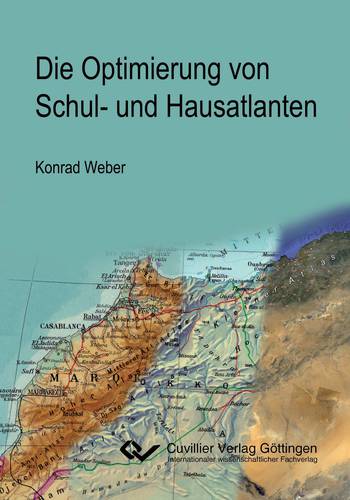
Die Optimierung von Schul- und Hausatlanten (English shop)
Analysen und Empfehlungen
Konrad Weber (Author)Preview
Extract, PDF (650 KB)
Table of Contents, PDF (98 KB)
Kurzbeschreibung
Atlanten verbinden die wissenschaftliche Geographie mit dem allgemeinen Raumverständnis der Menschen. Von Hausatlanten wird erwartet, dass sie die Geographie, wie sie in Medien und Gesellschaft zur Sprache kommt, erklären können. Von Schulatlanten erwartet man, dass sie optimal im Schulunterricht eingesetzt werden können. Die Schwerpunkte der geographischen Forschung, die gesellschaftlichen und medienrelevanten Themen innerhalb der Geographie und des Geographieunterrichts sind in einem ständigen Wandel. So geschieht es schnell, dass die Atlanten an Aktualität verlieren; sie müssen fortlaufend umgestaltet werden. Die Atlanten erfahren eine permanente Weiterentwicklung, indem sie den gegenwärtigen Anforderungen angepasst werden. Das Streben nach dem Optimum prägt die Atlanten immer wieder neu.
In dieser Studie soll ersichtlich werden, welcher Inhalt von Atlanten sich über Jahrzehnte bewährt hat und welcher Inhalt für die gegenwärtige Zeit für einen Atlas optimal ist. Die Frage nach dem optimalen Atlas ist eine Frage nach den geographischen Themen, die in einem Atlas enthalten sein sollen, und in welchem Umfang und Zusammenhang sie dargestellt werden sollen. Um dieser Frage nachzugehen, wurden 118 Atlanten aus verschiedenen Staaten inhaltlich analysiert. Zudem wurde der Inhalt der Atlanten mit den Anforderungen von Lehrplänen und mit geographischen Themen in Massenmedien verglichen.
Es zeigte sich, dass die Atlanten inhaltlich optimiert werden müssen, damit sie dem Gebrauch in der Schule und zu Hause besser entsprechen. Wie ein optimaler Atlas der Gegenwart gesamthaft aussehen soll, wird abschliessend mit einem Inhaltsverzeichnis (Kap. 5) dargelegt. Zudem werden zahlreiche Karten mit interessanten und gelungenen Ansätzen herausgegriffen, gegebenenfalls weiterentwickelt, diskutiert und kommentiert. Diese Studie soll die Atlanten, die schon einen langen Weg der Entwicklung hinter sich haben, auch in ihrer zukünftigen Entwicklung begleiten.
Description
For centuries atlases have been a bridge between scientific geography and the geographical understanding of the people. General atlases should explain the geographical knowledge that is disseminated in media and society. The geographical education in school should optimally benefit from school atlases. The topics in geographical research are in permanent change; the same is true for the news and geography lessons in school. Therefore atlases rapidly run out of date which makes it indispensable to adapt the shape and content of an atlas every now and then. Hence, atlases are permanently refined to meet the new demands.
This work shows in which way general atlases and school atlases have been refined to the needs of their time. It is shown which atlas contents have been unchanged for a long time, but also which contents would lead atlases close to their optimal state. The question how an atlas can be designed to be close to the optimal state is a question of its content and appearance. To find an answer to this question 118 atlases from different countries were analysed. School programmes and media were also investigated to figure out how atlases cover the geographical interest of schools and everyday life.
The results show that the present atlases need to be optimized. A standard table of content was written to give an overview of the content an optimal atlas of the present time could have. Several maps with interesting and good contents are presented, further developed if necessary and discussed. This work should help to enable the next steps to develop atlases on the way towards their optimal state.
| ISBN-13 (Hard Copy) | 9783954043194 |
| ISBN-13 (eBook) | 9783736943193 |
| Final Book Format | A5 |
| Language | German |
| Page Number | 234 |
| Lamination of Cover | glossy |
| Edition | 1. Aufl. |
| Publication Place | Göttingen |
| Place of Dissertation | Basel |
| Publication Date | 2013-04-30 |
| General Categorization | Dissertation |
| Departments |
Geosciences
|
| Keywords | Atlas, Schulatlas, Entwicklung, Kartographie, Didaktik |


