| Departments | |
|---|---|
| Book Series (99) |
1415
|
| Nachhaltigkeit |
3
|
| Gesundheitswesen |
3
|
| Humanities |
2410
|
| Medienwissenschaften | 17 |
| Theology | 57 |
| Philosophy | 103 |
| Law | 430 |
| Economics | 863 |
| Social sciences | 423 |
| Sports science | 48 |
| Psychology | 233 |
| Educational science | 190 |
| History | 194 |
| Art | 111 |
| Cultural studies | 167 |
| Literary studies | 118 |
| Linguistics | 90 |
| Natural Sciences |
5428
|
| Engineering |
1820
|
| Common |
97
|
|
Leitlinien Unfallchirurgie
5. Auflage bestellen |
|
Table of Contents, Datei (55 KB)
Extract, Datei (300 KB)
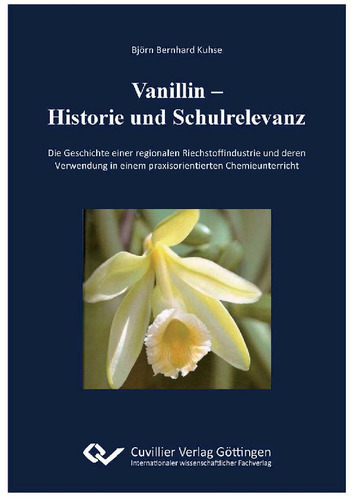
This study investigates the historical development of the first vanillin synthesis by Wilhelm Haarmann, starting from the cambial sap of spruce trees, and presents the life’s work of Wilhelm Haarmann alongside that of other chemists involved, such as Ferdinand Tiemann and Carl Reimer. Drawing on historical sources, it is shown how Tiemann and Haarmann succeeded in elucidating the structure of vanillin by means of degradation reactions. The synthesis of vanillin from clove oil, or eugenol, is based on the preliminary work of Erlenmeyer and Tiemann. The synthesis of vanillin from guaiacol was developed by Karl Reimer together with Ferdinand Tiemann; the principle of the reaction entered the history of chemistry as the Reimer-Tiemann synthesis. The production phase of vanillin was initiated in 1874 in Holzminden by Wilhelm Haarmann with the founding of the world’s first vanillin factory. This laid the foundation for the fragrance industry. In economic terms, vanillin production proved to be an extremely lucrative business in the 19th century, since vanillin was more valuable than gold. Wilhelm Haarmann ran the factory until his death in 1931; from a small plant in Holzminden a substantial production facility for fragrances had developed. Around vanillin, the product range had been expanded to include many fragrances and flavourings such as coumarin, heliotropin, irone and ionone. Furthermore, it is shown how the further development of vanillin synthesis into a biosynthetic process is realised at the successor company Symrise. In the experimental part of the work, information and practical instructions on the learning field of vanilla/vanillin are presented to pupils and teachers. In order to motivate pupils for practice-oriented chemistry lessons, this study has been developed with a series of experiments, for example the extraction and processing of spruce sap, a new laboratory synthesis of vanillin suitable for schools, as well as the isolation and analysis of isoconiferin.
| ISBN-13 (Printausgabe) | 3869554592 |
| ISBN-13 (Hard Copy) | 9783869554594 |
| ISBN-13 (eBook) | 9783736934597 |
| Language | German |
| Page Number | 190 |
| Edition | 1 Aufl. |
| Volume | 0 |
| Publication Place | Göttingen |
| Place of Dissertation | Universität Bielefeld |
| Publication Date | 2010-09-13 |
| General Categorization | Dissertation |
| Departments |
Educational science
Chemistry Domestic and nutritional science |
| URL to External Homepage | http://vanille-bernhard.blogspot.com/ |