
Cuvillier Verlag GmbH



| Departments | |
|---|---|
| Book Series (99) |
1415
|
| Nachhaltigkeit |
3
|
| Gesundheitswesen |
3
|
| Humanities |
2412
|
| Natural Sciences |
5430
|
| Mathematics | 230 |
| Informatics | 320 |
| Physics | 982 |
| Chemistry | 1371 |
| Geosciences | 131 |
| Human medicine | 246 |
| Stomatology | 10 |
| Veterinary medicine | 112 |
| Pharmacy | 147 |
| Biology | 837 |
| Biochemistry, molecular biology, gene technology | 121 |
| Biophysics | 25 |
| Domestic and nutritional science | 45 |
| Agricultural science | 1006 |
| Forest science | 201 |
| Horticultural science | 20 |
| Environmental research, ecology and landscape conservation | 149 |
| Engineering |
1821
|
| Common |
97
|
|
Leitlinien Unfallchirurgie
5. Auflage bestellen |
|
Advanced Search
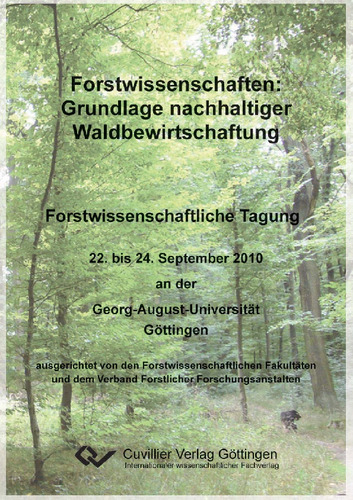
Forstwissenschaften: Grundlage nachhaltiger Waldbewirtschaftung (English shop)
Maurice Strunk (Author)Preview
Table of Contents, Datei (23 KB)
Extract, Datei (180 KB)
Current and projected climate change confronts forest nature conservation with new challenges. Both the conservation assets (e.g. species, populations, biotopes) and protection categories, as well as individual objectives in forest nature conservation, such as maintaining a native tree species composition or old stand phases, are affected by climate change. In addition, natural adaptation processes could be too slow for the high predicted rate of climate change, owing to the relatively long life span and low mobility of many species living in forests, as well as the strong human imprint on forest structure. The problem could be exacerbated by the interactions between the consequences of climate change and other anthropogenic influences, such as fragmentation, habitat destruction and nutrient/pollutant deposition. Conservation concepts based on static or historical conditions should be reconsidered in view of the changing conditions and extended to include dynamic aspects. It may be necessary to re-weight objectives in the future, for example giving greater importance to maintaining the functionality of ecosystems than to protecting particular species.
In the project “Waldnaturschutz und Klimawandel” (starting in spring 2009, duration 3 years), current guiding principles, reference systems and concrete objectives of nature conservation in forests are analysed and assessed against the background of climate change. The aim is to develop proposals for the further development of forest nature conservation in Germany. These can provide a framework for locally adapted action strategies.
Methodologically, a comprehensive analysis of current national and international literature is carried out. In a socio-empirical part, expert surveys on silvicultural and forest conservation adaptation measures already implemented in various regions of Germany are conducted, as well as scientific workshops. On this basis, the consequences of climate change for forest ecosystems are presented and possible adaptation strategies and difficulties from a forest nature conservation perspective are identified.
| ISBN-13 (Printausgabe) | 3869554827 |
| ISBN-13 (Hard Copy) | 9783869554822 |
| ISBN-13 (eBook) | 9783736934825 |
| Language | German |
| Page Number | 238 |
| Edition | 1 Aufl. |
| Volume | 0 |
| Publication Place | Göttingen |
| Publication Date | 2010-09-08 |
| General Categorization | Convention and Congress Book |
| Departments |
Forest science
|
| Keywords | Climate change, forest nature conservation, conference proceedings, congress volume, conference, volume of lectures |


