
Cuvillier Verlag GmbH



| Departments | |
|---|---|
| Book Series (99) |
1415
|
| Nachhaltigkeit |
3
|
| Gesundheitswesen |
3
|
| Humanities |
2410
|
| Natural Sciences |
5428
|
| Mathematics | 229 |
| Informatics | 320 |
| Physics | 982 |
| Chemistry | 1371 |
| Geosciences | 131 |
| Human medicine | 246 |
| Stomatology | 10 |
| Veterinary medicine | 112 |
| Pharmacy | 147 |
| Biology | 837 |
| Biochemistry, molecular biology, gene technology | 121 |
| Biophysics | 25 |
| Domestic and nutritional science | 45 |
| Agricultural science | 1005 |
| Forest science | 201 |
| Horticultural science | 20 |
| Environmental research, ecology and landscape conservation | 148 |
| Engineering |
1820
|
| Common |
97
|
|
Leitlinien Unfallchirurgie
5. Auflage bestellen |
|
Advanced Search
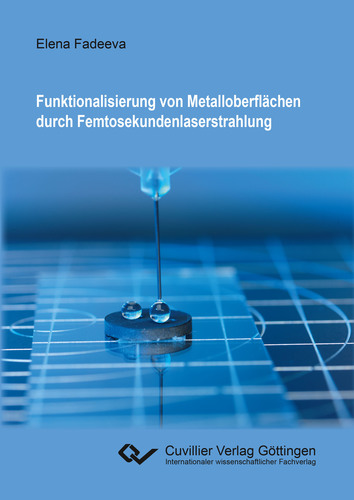
Funktionalisierung von Metalloberflächen durch Femtosekundenlaserstrahlung (English shop)
Elena Fadeeva (Author)Preview
Table of Contents, PDF (27 KB)
Extract, PDF (180 KB)
Superhydrophobic functionalisation of the surfaces of metal objects is of great importance for various applications. One of the main characteristics of superhydrophobic surfaces is their specific surface structure. In this work, a universal structuring technique – ablation by ultrashort-pulsed laser radiation – is applied in order to functionalise the surfaces of metal samples superhydrophobically. Furthermore, the interaction of the structured superhydrophobic surfaces with bacteria was investigated. It was shown that the increase in bacterial adhesion is related to the replacement of the air on superhydrophobic structured surfaces as a result of immersion in water. In the adhesion of cells to a fully wetted surface, geometric parameters of the structure play a decisive role.
| ISBN-13 (Hard Copy) | 9783954048861 |
| ISBN-13 (eBook) | 9783736948860 |
| Final Book Format | A5 |
| Language | German |
| Page Number | 150 |
| Lamination of Cover | glossy |
| Edition | 1. Aufl. |
| Publication Place | Göttingen |
| Place of Dissertation | Hannover |
| Publication Date | 2014-12-12 |
| General Categorization | Dissertation |
| Departments |
Physics
Biology Biophysics |
| Keywords | ultrashort pulsed laser radiation, superhydrophobic functionalization, cell adhesion |


