
Cuvillier Verlag GmbH



| Departments | |
|---|---|
| Book Series (99) |
1415
|
| Nachhaltigkeit |
3
|
| Gesundheitswesen |
3
|
| Humanities |
2411
|
| Natural Sciences |
5429
|
| Engineering |
1821
|
| Engineering | 292 |
| Mechanical and process engineering | 872 |
| Electrical engineering | 700 |
| Mining and metallurgy | 30 |
| Architecture and civil engineering | 76 |
| Common |
97
|
|
Leitlinien Unfallchirurgie
5. Auflage bestellen |
|
Advanced Search
Untersuchungen zur elektrisch unterstützten Abgasturboaufladung unter Berücksichtigung der Schadstoffemission (English shop)
Achim Müller (Author)Preview
Preface, PDF (65 KB)
Table of Contents, PDF (120 KB)
Extract, PDF (240 KB)
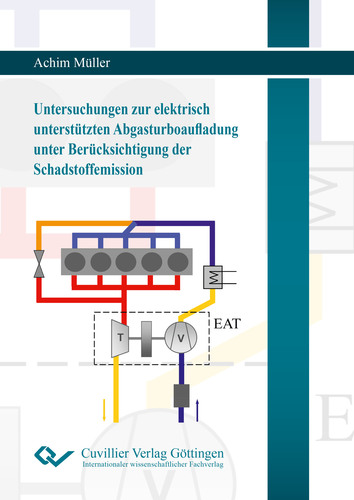
This study investigates the boosting potential of an electrically assisted exhaust gas turbocharger with electrically actuated variable turbine geometry. A synchronous machine is located on the same shaft as the compressor and the turbine. In engine operation, the greater volumetric efficiency and the associated possibility of injecting more fuel result in an increase in torque. A new engine control unit software is developed for the actuation of the synchronous machine and the variable turbine geometry. Measurements in the part-load range and during full-load accelerations are analysed. The analysis of the measurements shows that, on the one hand, more dynamic driving characteristics become possible when the synchronous machine is used and, on the other hand, fuel consumption decreases both in the part-load range and during full-load accelerations. Furthermore, it can be demonstrated that pollutant emissions are reduced with electrically assisted exhaust gas turbocharging. Soot emissions as well as NOX, CO2 and CO emissions are analysed.
| ISBN-13 (Hard Copy) | 9783954049622 |
| ISBN-13 (eBook) | 9783736949621 |
| Final Book Format | A5 |
| Language | German |
| Page Number | 162 |
| Lamination of Cover | matt |
| Edition | 1. Aufl. |
| Publication Place | Göttingen |
| Place of Dissertation | Magdeburg |
| Publication Date | 2015-04-07 |
| General Categorization | Dissertation |
| Departments |
Mechanical and process engineering
|
| Keywords | Boosting potential, electrically assisted turbocharging, variable turbine geometry, synchronous machine, compressor, turbine, volumetric efficiency, torque, engine control unit software, part-load range, full-load accelerations, more dynamic driving characteristics, fuel consumption, pollutant emissions, soot emissions, NOX, CO2 and CO emissions |


