
Cuvillier Verlag GmbH



| Departments | |
|---|---|
| Book Series (99) |
1415
|
| Nachhaltigkeit |
3
|
| Gesundheitswesen |
3
|
| Humanities |
2410
|
| Natural Sciences |
5428
|
| Mathematics | 229 |
| Informatics | 320 |
| Physics | 982 |
| Chemistry | 1371 |
| Geosciences | 131 |
| Human medicine | 246 |
| Stomatology | 10 |
| Veterinary medicine | 112 |
| Pharmacy | 147 |
| Biology | 837 |
| Biochemistry, molecular biology, gene technology | 121 |
| Biophysics | 25 |
| Domestic and nutritional science | 45 |
| Agricultural science | 1005 |
| Forest science | 201 |
| Horticultural science | 20 |
| Environmental research, ecology and landscape conservation | 148 |
| Engineering |
1820
|
| Common |
97
|
|
Leitlinien Unfallchirurgie
5. Auflage bestellen |
|
Advanced Search
Defektgitter und Gitterkomplexe – Einflüsse von Gegenionen und Lösungsmitteln auf ihre magnetischen Eigenschaften (English shop)
Markus Steinert (Author)Preview
Table of Contents, PDF (46 KB)
Extract, PDF (430 KB)
In the course of technologization, there is a growing demand for ever smaller memory components, switches and sensors. Since conventional methods of miniaturization are reaching their limits, attempts are being made to obtain molecule-based components via the bottom-up approach.
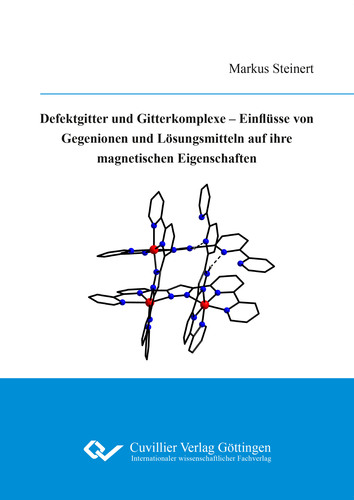
This work deals with a selection of [2×2] grid complexes that are considered promising candidates for the bottom-up approach. The homometallic (iron, cobalt and manganese) complexes presented here were investigated in detail by spectroscopic methods, whereby switchable spin states were found. In particular, the influence of solvent molecules and counterions on the magnetic properties was elaborated. Linking the grid complexes with ruthenium-based light-harvesting complexes represents a major step towards light-switchable molecular switches.
| ISBN-13 (Hard Copy) | 9783736991842 |
| ISBN-13 (eBook) | 9783736981843 |
| Final Book Format | A5 |
| Language | German |
| Page Number | 214 |
| Lamination of Cover | matt |
| Edition | 1. Aufl. |
| Publication Place | Göttingen |
| Place of Dissertation | Göttingen |
| Publication Date | 2016-01-12 |
| General Categorization | Dissertation |
| Departments |
Chemistry
Inorganic chemistry |


