
Cuvillier Verlag GmbH



| Departments | |
|---|---|
| Book Series (99) |
1418
|
| Nachhaltigkeit |
3
|
| Gesundheitswesen |
3
|
| Humanities |
2419
|
| Natural Sciences |
5433
|
| Mathematics | 230 |
| Informatics | 321 |
| Physics | 982 |
| Chemistry | 1371 |
| Geosciences | 131 |
| Human medicine | 247 |
| Stomatology | 10 |
| Veterinary medicine | 112 |
| Pharmacy | 147 |
| Biology | 838 |
| Biochemistry, molecular biology, gene technology | 121 |
| Biophysics | 25 |
| Domestic and nutritional science | 45 |
| Agricultural science | 1006 |
| Forest science | 201 |
| Horticultural science | 20 |
| Environmental research, ecology and landscape conservation | 149 |
| Engineering |
1825
|
| Common |
97
|
|
Leitlinien Unfallchirurgie
5. Auflage bestellen |
|
Advanced Search
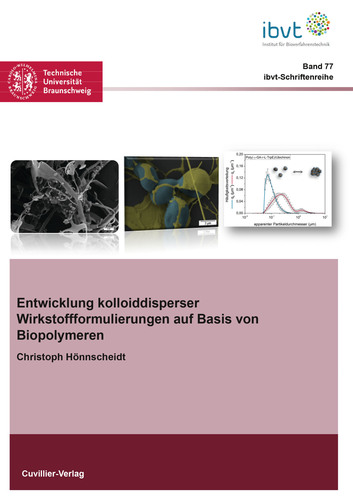
Entwicklung kolloiddisperser Wirkstoffformulierungen auf Basis von Biopolymeren (Volume 77) (English shop)
Christoph Hönnscheidt (Author)Preview
Table of Contents, PDF (120 KB)
Extract, PDF (200 KB)
The great advances in the production of nanoscale delivery systems now permit broad application to a variety of therapeutic questions. A particularly promising approach in this context is the development of tailor-made drug formulations. Such a development process now yields drug-loaded particles with a defined surface composition that exert a local effect at sites of inflammation. In this work, an approach to the development of a colloidally disperse ubiquinone formulation was pursued in which the poorly water-soluble radical scavenger could be converted into a suitable dosage form using specifically modified γ-PGA derivatives. The biopolymeric starting material γ-PGA was obtained from an optimised batch process using the strain Bacillus licheniformis. Here, large amounts of γ-PGA could be obtained in the cultivation broth over the phase-dependent course of the process. Purified γ-PGA then formed, as the key component, the basic scaffold for the stepwise conversion into a surface-active amphiphile. With this approach, colloidally disperse ubiquinone formulations based on electrostatic as well as steric stabilisation could be prepared. In the characterisation of the particle size distribution, significant differences in the physico-chemical behaviour under physiological conditions became apparent with respect to the different stabilisation strategies. On the basis of the anti-oxidative properties of ubiquinone, a cultivation process with Saccharomyces cerevisiae N34 was developed for in vitro studies, with which the stress-reducing effect of the colloidally disperse ubiquinone formulations on a deliberately oxidatively stressed yeast culture could be investigated. Compared with an already established polyvinyl alcohol-stabilised ubiquinone formulation, a significant reduction of oxidative stress in the living organism was achieved.
| ISBN-13 (Hard Copy) | 9783736992603 |
| ISBN-13 (eBook) | 9783736982604 |
| Final Book Format | A5 |
| Language | German |
| Page Number | 176 |
| Lamination of Cover | matt |
| Edition | 1. Aufl. |
| Book Series | Schriftenreihe des Institutes für Bioverfahrenstechnik der Technischen Universität Braunschweig |
| Volume | 77 |
| Publication Place | Göttingen |
| Place of Dissertation | Braunschweig |
| Publication Date | 2016-05-31 |
| General Categorization | Dissertation |
| Departments |
Chemistry
Organic chemistry Analytical chemistry Practical medicine Agricultural science Agricultural engineering Mechanical and process engineering Construction technology Fluid kinetic machines and reciprocating machines Automotive engineering Environmental technology |


