
Cuvillier Verlag GmbH



| Departments | |
|---|---|
| Book Series (99) |
1415
|
| Nachhaltigkeit |
3
|
| Gesundheitswesen |
3
|
| Humanities |
2412
|
| Natural Sciences |
5430
|
| Mathematics | 230 |
| Informatics | 320 |
| Physics | 982 |
| Chemistry | 1371 |
| Geosciences | 131 |
| Human medicine | 246 |
| Stomatology | 10 |
| Veterinary medicine | 112 |
| Pharmacy | 147 |
| Biology | 837 |
| Biochemistry, molecular biology, gene technology | 121 |
| Biophysics | 25 |
| Domestic and nutritional science | 45 |
| Agricultural science | 1006 |
| Forest science | 201 |
| Horticultural science | 20 |
| Environmental research, ecology and landscape conservation | 149 |
| Engineering |
1821
|
| Common |
97
|
|
Leitlinien Unfallchirurgie
5. Auflage bestellen |
|
Advanced Search
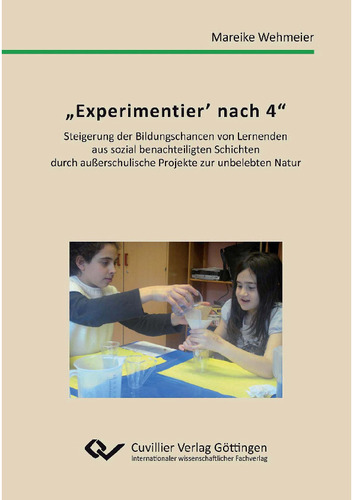
„Experimentier´ nach 4" (English shop)
Steigerung der Bildungschancen von Lernenden aus sozial benachteiligten Schichten durch außerschulische Projekte zur unbelebten Natur
Mareike Wehmeier (Author)Preview
Table of Contents, Datei (84 KB)
Extract, Datei (140 KB)
The aim of the present research project was to develop an out-of-school experimentation project for children and young people from socially disadvantaged backgrounds. At open child and youth welfare facilities in socially deprived areas, learners were to be introduced on a voluntary basis to everyday and career-oriented phenomena of inanimate nature. By means of experimental engagement, interest in scientific content as well as enjoyment of experimentation were to be awakened or increased in a positive learning atmosphere.
The starting point was the unequal educational opportunities that are more pronounced in Germany than in any other industrialised nation in the world. Social background determines educational pathways, school achievement and life chances. People with a migration background in particular find it difficult in this country to attain qualifying school-leaving certificates due to early selection. This disadvantage also continues on the apprenticeship and labour market.
Against this background, it is nothing short of disastrous that the urgently needed skilled workers are lacking for a large number of positions – especially in the scientific and technical field. The target groups hitherto neglected in the education system undoubtedly have the potential to compensate for this shortage of skilled workers. The earliest possible and targeted promotion of STEM qualifications therefore offers opportunities not only for the individual learner, but also for Germany’s future viability.
Despite manifold efforts, the school system has so far not succeeded in ensuring equitable educational opportunities. For this reason, the out-of-school sphere was deliberately chosen as the field of work for this research approach. Contrary to the statutory anchoring of an educational mandate that also encompasses “natural science and technical education”, open child and youth work (OKJA) is used only rudimentarily for the conveyance of science education. Yet it is precisely there that opportunities lie hidden to reach people from socially disadvantaged backgrounds through low-threshold offerings and to introduce them, far removed from school performance pressure, to STEM topics with which they otherwise have little contact in this form.
In several work steps, the twelve-week experimentation series entitled “Experimentier’ nach 4” was developed and optimised and carried out in various OKJA facilities. At the centre of the deliberately open-ended empirical investigation were three hypotheses, by means of which it was to be examined (1) with what degree of commitment the children and young people take up the voluntary experimentation offering over a longer period of time, (2) whether affective and cognitive access to topics of inanimate nature can be facilitated by out-of-school experimentation projects within the framework of OKJA, and (3) whether this can achieve an initial approach among learners to the everyday and occupational relevance of scientific phenomena. With regard to the guiding questions, a number of answers could be found in the course of the investigation.
Three quarters of the participating children and young people voluntarily took up the experimentation offering at at least half of the sessions offered. Beyond mere attendance, further research findings showed that the learners took up the offering with a sustained commitment. They participated actively and also reported on the experiments they had carried out outside the facilities. It was likewise possible to demonstrate that fundamental principles had been internalised and that phenomena could in part be transferred to other experiments. In addition, attitudes towards chemical and physical content and towards the everyday and occupational relevance of scientific topics changed.
In cooperation with the Handwerkskammer OWL, the voluntary commitment of the children and young people was recognised in the form of a certificate. This can be attached to future job applications and, alongside the basic scientific knowledge acquired and the development of soft skills, may possibly contribute to improving the educational and application prospects of the socially disadvantaged.
On the basis of the results, framework conditions were formulated that provide indications of the circumstances under which open child and youth facilities can be used productively for experimentation projects of this kind. The present investigation represents only a first step in a potentially promising direction. On the way to permanent establishment in the open sphere of child and youth welfare, a number of courses still have to be set.
In further smaller intervention studies in the area of family education centres, attention was therefore directed beyond young people to other groups of people as well. On the one hand, staff of the OKJA were introduced to topics of inanimate nature in in-service training courses. On the other hand, within the framework of the “Eltern-Uni”, parents and grandparents with a migration background were invited to engage experimentally with everyday chemical and physical phenomena.
Both approaches were intended to show that experimentation can be an exciting and worthwhile leisure activity for children and young people that can be readily integrated into everyday family life or the leisure sphere. The further development of these approaches could provide a promising basis for follow-up research. Among the central questions are: How can OKJA staff be motivated to develop and implement experimentation offerings independently? How might it be possible to awaken in family members an enjoyment of experimenting together with their children and thus to improve the image of chemistry and physics?
Further starting points for follow-up research projects also present themselves. For instance, a more intensive emphasis on the occupational perspective could be worthwhile. One route could be cooperation with classic pre-vocational measures. Here, however, it would be advisable to place the focus on somewhat older adolescents. The present investigation has shown that ten- to 14-year-olds have only diffuse notions of their occupational future and the competences necessary in connection with it, and that career choice is hardly an issue at this age.
An additional approach could be the investigation of the gender aspect. Can adolescent girls in particular be strengthened in the STEM field through out-of-school experimentation projects in gender-homogeneous groups?
It seems likely that out-of-school engagement with topics of inanimate nature also has an influence on the school sphere. Some participants stated after the experimentation series that they now took more enjoyment in science subjects at school. It could be interesting to investigate whether the children’s enthusiasm for scientific content in the out-of-school sphere also corresponds to their school achievement. Conceivable here would be, for example, a study with two comparison groups as well as surveys of the subject teachers.
This broad spectrum of research questions makes clear that the research field entered with this investigation is by no means exhausted. On the way to a future with greater educational equity and competent young talent, Germany must succeed in linking formal educational institutions more closely with out-of-school facilities. On the other hand, it is necessary for the facilities of open child and youth welfare to make use of their potential and to fulfil their educational mandate more strongly, also with regard to the conveyance of STEM qualifications. The present investigation was able to point out ways of doing so and perhaps to build a first bridge.
| ISBN-13 (Printausgabe) | 3954040484 |
| ISBN-13 (Hard Copy) | 9783954040483 |
| ISBN-13 (eBook) | 9783736940482 |
| Final Book Format | A5 |
| Language | German |
| Page Number | 240 |
| Lamination of Cover | matt |
| Edition | 1 Aufl. |
| Volume | 0 |
| Publication Place | Göttingen |
| Place of Dissertation | Bielefeld |
| Publication Date | 2012-03-14 |
| General Categorization | Dissertation |
| Departments |
Chemistry
|
| Keywords | Chemistry education |


