
Cuvillier Verlag GmbH



| Departments | |
|---|---|
| Book Series (99) |
1415
|
| Nachhaltigkeit |
3
|
| Gesundheitswesen |
3
|
| Humanities |
2411
|
| Natural Sciences |
5429
|
| Engineering |
1821
|
| Engineering | 292 |
| Mechanical and process engineering | 872 |
| Electrical engineering | 700 |
| Mining and metallurgy | 30 |
| Architecture and civil engineering | 76 |
| Common |
97
|
|
Leitlinien Unfallchirurgie
5. Auflage bestellen |
|
Advanced Search
MoreGait – Ein Rehabilitationsroboter zur Gangtherapie im Heimbereich (English shop)
Markus Knestel (Author)Preview
Table of Contents, Datei (53 KB)
Extract, Datei (240 KB)
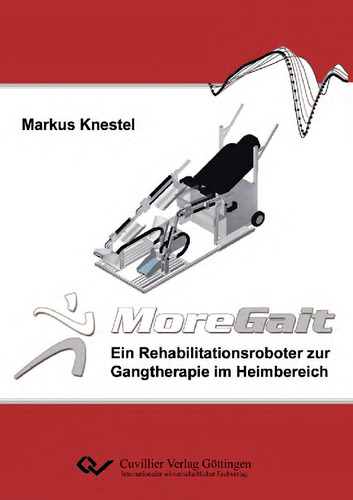
MoreGait – A rehabilitation robot for gait therapy in the home environment
In people with lesions of the central nervous system, the ability to walk, and thus mobility in everyday life, is usually severely restricted. Since the introduction of locomotion training on the treadmill in the mid-1990s, the benefits of this function-oriented therapy have been demonstrated in clinical studies with neurological patients. The availability of robotic locomotion machines makes it possible to overcome the limitations of treadmill training assisted manually by therapists with respect to the duration of a therapy session and the physiological gait pattern. The use of these large devices, which are tied to the clinical setting, can just about compensate for the ever shorter duration of initial rehabilitation. After the inpatient stay, however, maintaining the therapeutically necessary training intensity in order to preserve or extend the acquired abilities can only be achieved with considerable effort. This work was carried out within the framework of the key experiment project MotionTherapy@Home (01EZ601, 01EZ602), funded since 2006 by the German Federal Ministry of Education and Research (BMBF), which, in a cooperation between the University of Ulm and the Orthopaedic University Hospital Heidelberg, aimed to demonstrate that function-oriented locomotion therapy can also be carried out safely and effectively in the domestic environment using device technology reduced to the technical minimum and incorporating intensive sensory stimulation. The features decisive for therapeutic success appear to consist of the physiological movement of the legs at normal walking speed and the cyclical, step-phase-related loading of the sole of the foot.
The central content of this work is the design of the novel device concept, the control engineering handling of the drives modelled on biological muscle, the development of a training feedback component for training assessment and motivation, the construction of a novel stimulation unit for stimulating the sole of the foot, the development of a remote monitoring function reduced to the essentials, as well as the complete integration of all these components into a laboratory prototype applicable to patients, which was built five times in a small series and is currently being evaluated in a pilot study. Despite considerable simplifications and reductions in the machine design, the first study results are comparable to the reported successes of the large clinical devices.
| ISBN-13 (Printausgabe) | 3869553189 |
| ISBN-13 (Hard Copy) | 9783869553184 |
| ISBN-13 (eBook) | 9783736933187 |
| Final Book Format | A5 |
| Language | German |
| Page Number | 258 |
| Edition | 1 Aufl. |
| Volume | 0 |
| Publication Place | Göttingen |
| Place of Dissertation | Universität Ulm |
| Publication Date | 2010-04-20 |
| General Categorization | Dissertation |
| Departments |
Engineering
|
| Keywords | Medical engineering, Rehabilitation of neurological patients |


