
Cuvillier Verlag GmbH



| Departments | |
|---|---|
| Book Series (99) |
1415
|
| Nachhaltigkeit |
3
|
| Gesundheitswesen |
3
|
| Humanities |
2413
|
| Natural Sciences |
5430
|
| Mathematics | 230 |
| Informatics | 320 |
| Physics | 982 |
| Chemistry | 1371 |
| Geosciences | 131 |
| Human medicine | 246 |
| Stomatology | 10 |
| Veterinary medicine | 112 |
| Pharmacy | 147 |
| Biology | 837 |
| Biochemistry, molecular biology, gene technology | 121 |
| Biophysics | 25 |
| Domestic and nutritional science | 45 |
| Agricultural science | 1006 |
| Forest science | 201 |
| Horticultural science | 20 |
| Environmental research, ecology and landscape conservation | 149 |
| Engineering |
1822
|
| Common |
97
|
|
Leitlinien Unfallchirurgie
5. Auflage bestellen |
|
Advanced Search
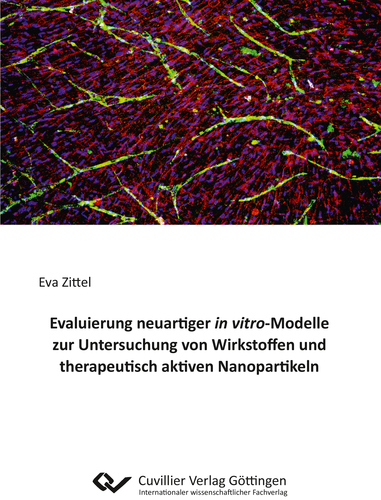
Evaluierung neuartiger in vitro-Modelle zur Untersuchung von Wirkstoffen und therapeutisch aktiven Nanopartikeln (English shop)
Eva Zittel (Author)Preview
Extract, PDF (1.3 MB)
Table of Contents, PDF (560 KB)
Despite manifold advances in medical research and the abundance of newly developed substances as potential active agents, there are still diseases that cannot be treated with sufficient efficacy. One of the greatest challenges here lies in the investigation and evaluation of drug candidates, which is a very time- and cost-intensive process. At the same time, there is a high failure rate of test substances even in late phases of drug development, since the results of the various test models are often difficult to translate from one to another. High-throughput screening in in vitro systems with simple cell cultures is followed by in vivo experiments in various animal models, before initial studies are finally conducted in a small group of human subjects. However, neither the transferability of findings from cell culture to the animal organism nor the relevance of these very animal models for human physiology is guaranteed. Within the framework of this project, various in vitro models for the testing of active agents and drug carriers were therefore to be investigated, adapted and evaluated. The focus was, on the one hand, on two therapeutically applicable nanoparticles that had to be characterised, and, on the other hand, on advanced in vitro systems with three-dimensional cell cultures and microfluidic organ-on-a-chip models.
| ISBN-13 (Hard Copy) | 9783736999589 |
| ISBN-13 (eBook) | 9783736989580 |
| Final Book Format | A5 |
| Language | German |
| Page Number | 142 |
| Lamination of Cover | matt |
| Edition | 1. |
| Publication Place | Göttingen |
| Place of Dissertation | Karlsruhe |
| Publication Date | 2019-02-01 |
| General Categorization | Dissertation |
| Departments |
Chemistry
Inorganic chemistry Organic chemistry Biology Microbiology and biotechnology |
| Keywords | 3D cell culture, tissue engineering, organ-on-a-chip, nanoparticles, drug delivery, tumour therapy, AlO(OH), angiogenesis, biocompatibility, blood vessel, chemotherapeutics, doxorubicin, exosomal RNA, endothelium, fibrin gel, gadolinium, tissue reconstruction, semicircular channel, hybrid material, in vitro evaluation, in vitro models, small airways, co-culture, drug development, microfluidics, nanoscale hollow spheres, organotypic, organ-specific, photoactivation, photodynamic therapy, photosensitiser, phthalocyanine, porous membrane, qPCR, spheroids, (test systems), therapeutically active, transendothelial transport, transwell system, (tumour), vascularisation, cytotoxicity |
| URL to External Homepage | https://www.itg.kit.edu/schepers/index.php |


