
Cuvillier Verlag GmbH



| Departments | |
|---|---|
| Book Series (99) |
1415
|
| Nachhaltigkeit |
3
|
| Gesundheitswesen |
3
|
| Humanities |
2411
|
| Natural Sciences |
5430
|
| Mathematics | 230 |
| Informatics | 320 |
| Physics | 982 |
| Chemistry | 1371 |
| Geosciences | 131 |
| Human medicine | 246 |
| Stomatology | 10 |
| Veterinary medicine | 112 |
| Pharmacy | 147 |
| Biology | 837 |
| Biochemistry, molecular biology, gene technology | 121 |
| Biophysics | 25 |
| Domestic and nutritional science | 45 |
| Agricultural science | 1006 |
| Forest science | 201 |
| Horticultural science | 20 |
| Environmental research, ecology and landscape conservation | 149 |
| Engineering |
1821
|
| Common |
97
|
|
Leitlinien Unfallchirurgie
5. Auflage bestellen |
|
Advanced Search
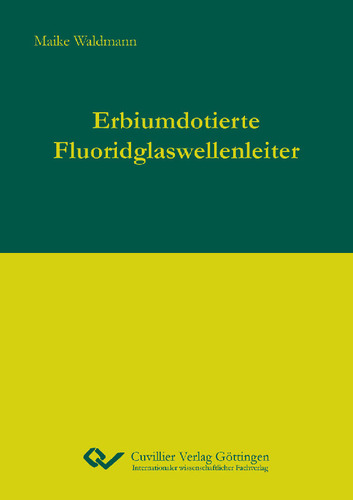
Erbiumdotierte Fluoridglaswellenleiter (English shop)
Maike Waldmann (Author)Preview
Table of Contents, Datei (34 KB)
Extract, Datei (130 KB)
Owing to its high transparency from the ultraviolet to the near-infrared spectral range and its low phonon energies, fluoride glass is exceptionally well suited for applications in the visible spectral range. As a host material, it can incorporate large amounts of rare-earth ions as dopants. Erbium-doped ZBLAN exhibits strong green fluorescence when excited at wavelengths of 970–980 nm, which arises from the stepwise absorption of two photons in an upconversion process into the long-lived excited state 4S3/2.
The detailed analysis of the thermal properties of the fluoride glass ZBLAN and of further glasses containing either a certain proportion of lead or a proportion of hafnium provides insight into glass stability, thermal expansion and characteristic temperatures. Refractometry and ellipsometry show to what extent the refractive index can be varied by lead and hafnium contents. Not least, this information is helpful for the choice of a suitable substrate material, which fell on CaF2.
The modified spin-coating process has proven to be a successful method for producing low-loss glass films with very smooth surfaces from fluoride glass. The glass films can be doped with arbitrary rare-earth ions at different concentrations. The fluorescence spectra of erbium-doped glass pieces and films in the green spectral range are comparable. By means of photolithography and a subsequent wet-chemical etching process, the films can be structured into ridge waveguides. Microscope images of IR-pumped and fluorescing ridge waveguides show no visible scattering losses at the structured edges, so that the losses additionally introduced by the etching are low.
The fabricated erbium-doped ridge waveguides made of fluoride glass have cross sections between 40 × 40 µm2 and 40 × 230 µm2 and exhibit waveguiding. A simulation showed that an IR-pumped, efficient green waveguide laser is feasible, but requires high pump powers in order to reach the laser threshold. The combination of several approaches should, however, lead to success: on the one hand, co-doping with ytterbium can improve the pump absorption. Furthermore, a smaller waveguide cross section, together with good focusing and coupling of the pump laser into the waveguide, leads to higher intensities in the resonator. Smaller waveguide cross sections are achieved by thinner layers, which in turn are obtained by applying a cover layer of fluoride glass.
The optical and thermal properties of erbium-doped ZBLAN, combined with further optimised methods for the fabrication of low-loss waveguides, will in the foreseeable future lead to the realisation of a compact green laser source.
| ISBN-13 (Printausgabe) | 3869552980 |
| ISBN-13 (Hard Copy) | 9783869552989 |
| ISBN-13 (eBook) | 9783736932982 |
| Language | German |
| Page Number | 114 |
| Edition | 1 Aufl. |
| Volume | 0 |
| Publication Place | Göttingen |
| Place of Dissertation | TU Braunschweig |
| Publication Date | 2010-03-30 |
| General Categorization | Dissertation |
| Departments |
Physics
Engineering Electrical engineering |
| Keywords | Photonics, high-frequency engineering, materials science |


