
Cuvillier Verlag GmbH



| Departments | |
|---|---|
| Book Series (99) |
1415
|
| Nachhaltigkeit |
3
|
| Gesundheitswesen |
3
|
| Humanities |
2413
|
| Medienwissenschaften | 17 |
| Theology | 57 |
| Philosophy | 103 |
| Law | 430 |
| Economics | 864 |
| Social sciences | 423 |
| Sports science | 48 |
| Psychology | 233 |
| Educational science | 190 |
| History | 194 |
| Art | 111 |
| Cultural studies | 168 |
| Literary studies | 119 |
| Linguistics | 91 |
| Natural Sciences |
5430
|
| Engineering |
1822
|
| Common |
97
|
|
Leitlinien Unfallchirurgie
5. Auflage bestellen |
|
Advanced Search
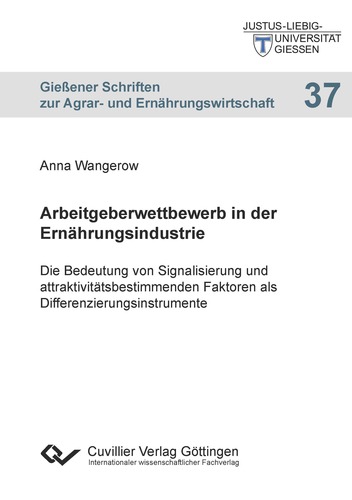
Arbeitgeberwettbewerb in der Ernährungsindustrie (Volume 37) (English shop)
Die Bedeutung von Signalisierung und attraktivitätsbestimmenden Faktoren als Differenzierungsinstrumente
Anna Wangerow (Author)Preview
Extract, PDF (150 KB)
Table of Contents, PDF (110 KB)
The lack of skilled workers reveals inefficiencies in the employer-employee market and points to a fundamental attractiveness problem of the food industry in the competition for high potentials. Companies are faced with increasing staffing problems (e.g., vacancies). This dissertation aims to explain the construct of employer attractiveness in order to identify differentiation opportunities within employer branding. The theoretical basis is the concept of signaling linked to the brand equity theory. The established functional-symbolic framework of employer marketing is supplemented by the facet of experience-based employer image characteristics and product attractiveness. Using structural equation analysis, a hierarchical component model is estimated by applying the sequential latent variable score method (two-stage approach). The results show that functional (‘objective’) employer image characteristics – characterized as credence qualities – have little relevance. Experience-based/symbolic (‘subjective’) characteristics serve to create ‘real’ differentiation in the ‘war for talents’. Experiences with the employer brand arouse curiosity and thus triggers students to apply for the position.
| ISBN-13 (Hard Copy) | 9783736975040 |
| ISBN-13 (eBook) | 9783736965041 |
| Final Book Format | A5 |
| Language | German |
| Page Number | 260 |
| Lamination of Cover | matt |
| Edition | 1. |
| Book Series | Gießener Schriften zur Agrar- und Ernährungswirtschaft |
| Volume | 37 |
| Publication Place | Göttingen |
| Place of Dissertation | Gießen |
| Publication Date | 2021-11-05 |
| General Categorization | Dissertation |
| Departments |
Economics
Business economics Social sciences Empirical social research Labor science Domestic and nutritional science Agricultural science |
| Keywords | Employer competition, employer attractiveness, employer image, employer brand, employer branding, employer brand associations, employer value proposition, employer reputation, employer characteristics, employer marketing, food industry, employer-employee market, shortage of skilled workers, specialists and managers, personnel recruitment, staffing processes, staffing problems, vacancies, turnover, career entry decision, information economics, hidden intention, credence qualities, signaling, brand value, differentiation, positioning, differentiation instruments, differentiation strategy, functional-symbolic framework, experience attributes, experience scale, product attractiveness, structural equation analysis, structural equation modeling, hierarchical component models, two-stage approach, factor score based approach, new work, Employer competition, employer attractiveness, employer image, employer brand, employer branding, employer brand associations, employer value proposition, employer reputation, employer characteristics, employer marketing, food industry, employer-employee-market, war for talents, high potentials, recruiting, recruitment, staffing problems, vacancies, fluctuation, career entry decision, information economics, hidden intention, credence qualities, signaling, brand value, differentiation, positioning, differentiation instruments, differentiation strategy, instrumental-symbolic framework, experience attributes, experience scale, product attractiveness, structural equation analysis, structural equation modeling, hierarchical component model, two-stage-approach, sequential latent variable score method, new work, variance inflation factor, confidence interval, demographic change, demographic change, labour supply, labour supply |


