
Cuvillier Verlag GmbH



| Departments | |
|---|---|
| Book Series (99) |
1415
|
| Nachhaltigkeit |
3
|
| Gesundheitswesen |
3
|
| Humanities |
2410
|
| Medienwissenschaften | 17 |
| Theology | 57 |
| Philosophy | 103 |
| Law | 430 |
| Economics | 863 |
| Social sciences | 423 |
| Sports science | 48 |
| Psychology | 233 |
| Educational science | 190 |
| History | 194 |
| Art | 111 |
| Cultural studies | 167 |
| Literary studies | 118 |
| Linguistics | 90 |
| Natural Sciences |
5428
|
| Engineering |
1820
|
| Common |
97
|
|
Leitlinien Unfallchirurgie
5. Auflage bestellen |
|
Advanced Search
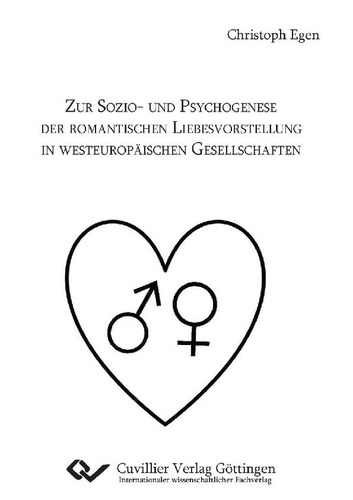
Zur Sozio- und Psychogenese der romantischen Liebesvorstellung in westeuropäischen Gesellschaften (English shop)
Christoph Egen (Author)Preview
Table of Contents, Datei (24 KB)
Extract, Datei (49 KB)
“The task of social scientists is to make intelligible to themselves and to others the changing patterns that people form with one another, the nature of these bonds, the structure of this change.” With this quotation from Norbert Elias, Christoph Egen introduces his remarkable study “Zur Sozio- und Psychogenese der romantischen Liebesvorstellung in westeuropäischen Gesellschaften”. The central thesis of this vivid account is that the romantic conception of love is “not a rigid anthropological universal, but a social process”. He seeks to trace this, among other things, by means of Elias’s process sociology, which he regards as a good point of departure for a sociology of emotions that is still largely lacking. Egen has carefully examined not only Elias’s publications with regard to his topic, but also his unpublished papers. This effort has paid off, as can be seen, for example, in the extraordinarily perceptive description of modern transformations of marriage by Elias’s grandfather: “‘In my day,’ my grandfather said, ‘a marriage looked like a low hearth fire that slowly grows warmer. Today it looks like a blazing fire that slowly cools down.’” The observation that, in highly unequal power relations, “often enough the rebellion, the desire to be able to resist, is repressed from consciousness” is likewise a fine find from the archival material. The author consistently demonstrates the connections between social and psychological events. Cultural forms of behaviour, he quotes Vygotsky, are not simply acquired skills but structure people’s inner forms of relating. Here levels of reality interlock very closely which, in the prevailing scientific system, are otherwise often treated as analytically strictly separate. All in all, this is a study that shows Elias’s theory of civilisation from a hitherto little illuminated side and applies it in a way that develops it further.
Hans-Peter Waldhoff
| ISBN-13 (Printausgabe) | 3869551992 |
| ISBN-13 (Hard Copy) | 9783869551999 |
| ISBN-13 (eBook) | 9783736931992 |
| Final Book Format | A5 |
| Language | German |
| Page Number | 168 |
| Edition | 1 Aufl. |
| Volume | 0 |
| Publication Place | Göttingen |
| Publication Date | 2009-12-14 |
| General Categorization | Non-Fiction |
| Departments |
Social sciences
|


