
Cuvillier Verlag GmbH



| Departments | |
|---|---|
| Book Series (99) |
1415
|
| Nachhaltigkeit |
3
|
| Gesundheitswesen |
3
|
| Humanities |
2412
|
| Natural Sciences |
5430
|
| Mathematics | 230 |
| Informatics | 320 |
| Physics | 982 |
| Chemistry | 1371 |
| Geosciences | 131 |
| Human medicine | 246 |
| Stomatology | 10 |
| Veterinary medicine | 112 |
| Pharmacy | 147 |
| Biology | 837 |
| Biochemistry, molecular biology, gene technology | 121 |
| Biophysics | 25 |
| Domestic and nutritional science | 45 |
| Agricultural science | 1006 |
| Forest science | 201 |
| Horticultural science | 20 |
| Environmental research, ecology and landscape conservation | 149 |
| Engineering |
1821
|
| Common |
97
|
|
Leitlinien Unfallchirurgie
5. Auflage bestellen |
|
Advanced Search
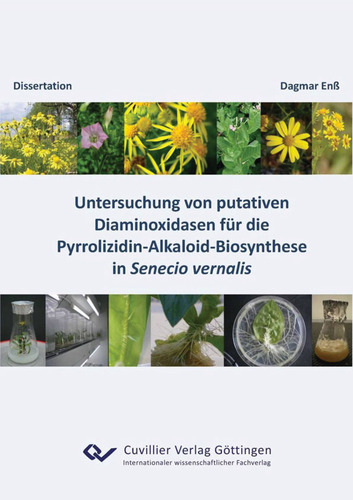
Untersuchung von putativen Diaminoxidasen für die Pyrrolizidin-Alkaloid-Biosynthese (English shop)
Dagmar Enß (Author)Preview
Table of Contents, Datei (87 KB)
Extract, Datei (120 KB)
Three diamine oxidases (SVAO1, SVAO2 and SVAO3) were identified from the pyrrolizidine alkaloid (PA)-containing plant Senecio vernalis (Denker, 2008). In order to investigate their possible involvement in PA biosynthesis, SVAO1 and SVAO2 had already been heterologously expressed in the past (Denker, 2008). In the present work, SVAO3 was heterologously expressed in E. coli, which led to the formation of inclusion bodies. Coexpression with chaperones likewise did not result in the expression of soluble protein. The previous assumption that SVAO3 might represent a small gene family was confirmed, since two further members of this family could be identified in the course of this work.
In order to draw conclusions about the function of the three SVAOs from their site of expression, tissue-specific RT-PCRs were carried out in S. vernalis. Transcripts of the svao3 gene were localised in all plant organs of S. vernalis, those of the svao2 gene in leaf and shoot, and transcripts of the svao1 gene only in the root. Since the entire PA biosynthesis in S. vernalis is located in the root, SVAO1 became the “most promising candidate” of the three SVAOs for a possible involvement in PA biosynthesis. In situ hybridisations were also carried out in the root of S. vernalis to localise the mRNA of the three SVAOs. Using a combination of probes against mRNA of the svao1 and svao3 genes, a signal was detected close to the site of expression of homospermidine synthase, the entry enzyme of PA biosynthesis. This gave rise to the assumption that the diamine oxidase sought might possess structural features of both SVAO1 and SVAO3.
In order to investigate the functions of the three SVAOs in planta, S. vernalis and Nicotiana tabacum were transformed with constructs for the overexpression and down-regulation of the expression of the three SVAOs by means of Agrobacterium rhizogenes. Both GUS assays and PCRs with the genomic DNA of the hairy root (HR) clones confirmed the successful transformation of both experimental plants. S. vernalis was thereby transformed with A. rhizogenes for the first time. PA analyses of the Senecio HRs, however, showed a tendency towards a down-regulation of total PAs only in the SVAO3 overexpression culture, possibly caused by the cosuppression of a DAO involved in PA biosynthesis. An analysis of the transcript levels of the foreign DNA by semiquantitative RT-PCR was also unable to confirm the expression of the integrated SVAO constructs. In contrast, transcripts of the enhanced green fluorescent protein (egfp) gene integrated into the cloning cassette were detected in some RNAi clones. No transcripts of the egfp gene were detected in the overexpression HR cultures. This may be attributable to the rolD promoter used in the overexpression constructs.
In tobacco, the overexpression of SVAO1 and SVAO3 did not lead to any change in the alkaloid spectrum that could have been detected by 1H NMR. RT-PCRs of some selected samples showed, however, that SVAO1 was partly expressed.
| ISBN-13 (Printausgabe) | 3869551445 |
| ISBN-13 (Hard Copy) | 9783869551449 |
| ISBN-13 (eBook) | 9783736931442 |
| Language | German |
| Page Number | 204 |
| Edition | 1 Aufl. |
| Volume | 0 |
| Publication Place | Göttingen |
| Place of Dissertation | Universität Kiel |
| Publication Date | 2009-11-05 |
| General Categorization | Dissertation |
| Departments |
Pharmacy
|


