
Cuvillier Verlag GmbH



| Departments | |
|---|---|
| Book Series (99) |
1418
|
| Nachhaltigkeit |
3
|
| Gesundheitswesen |
3
|
| Humanities |
2418
|
| Natural Sciences |
5433
|
| Engineering |
1825
|
| Engineering | 292 |
| Mechanical and process engineering | 875 |
| Electrical engineering | 701 |
| Mining and metallurgy | 30 |
| Architecture and civil engineering | 76 |
| Common |
97
|
|
Leitlinien Unfallchirurgie
5. Auflage bestellen |
|
Advanced Search
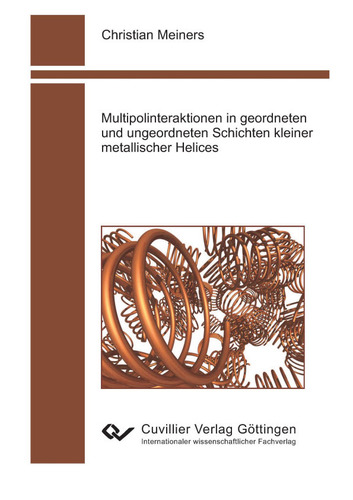
Multipolinteraktionen in geordneten und ungeordneten Schichten kleiner metallischer Helices (English shop)
Christian Meiners (Author)Preview
Table of Contents, Datei (77 KB)
Extract, Datei (490 KB)
Research in the field of complex, composite materials aims to characterise electromagnetically effective layers. Capturing the interactions between the individual basic building blocks is an essential element in developing an understanding of the scattering behaviour of such structures. Only with a knowledge-based approach and an accurate model is it possible to optimise functional layers with respect to their electromagnetic properties.
The present work considers arrangements of small metallic helices, known from the field of chiral materials for the microwave range that emerged in the early 1990s. The geometric dimensions of the particles are mostly small compared to the wavelength, and they are characterised by pronounced scattering behaviour within the resonance. This circumstance predestines small metallic helices, for example, for use in microwave absorbers. For modelling such layers, mixing formulas known from the theory of effective media as well as fully numerical approaches have recently become established. A disadvantage, however, is that the mechanisms of mutual coupling are mostly taken into account only inadequately or elude a more precise interpretation.
The objective of this work is the investigation of the scattering behaviour of the helices in layers with different degrees of order, within and outside the resonance. The transition from a layer constructed purely periodically in two dimensions to the case of randomness (chiral material) takes place continuously, in order to systematically cover the space of possible constellations.
To obtain an accurate physical picture of the scattering mechanisms, a complete model of a single scatterer based on a T-matrix is first developed in this work. The latter links the excitation amplitudes of the incident and scattered spherical waves, which are equivalent to the scattered fields of multipoles of corresponding order. The formulation of a scattering theory to account for the presence of further particles occupies a large part of the work. Here, the extension to periodic arrangements should be mentioned in particular. The comparison of the results with those of a commercial simulation tool, using the example of a special periodic arrangement, corroborates the validity of the model. As in the majority of the investigations in this work, the central question is which multipole moments play a role in the interaction.
Starting from the structure of maximum order, the periodicity is finally “softened” step by step by including statistical distributions of the scatterers (position, orientation). A numerical averaging approach is chosen for modelling these arrangements. Thus the results of several periodic layers with randomly chosen unit cells are averaged. Detailed investigations ultimately provide information on how large the unit cell must be, or how many helices must be placed within a unit cell, in order to obtain consistent results. The studies are subsequently extended to multilayer arrangements. For the case in which the application of effective material parameters appears conceivable owing to a certain minimum thickness of the layer, it is examined on a sample basis under which circumstances and with which residual errors mixing formulas can be used for characterisation.
A number of measurements on selected layers substantiate the model and the averaging theory it contains. The inclusion of manufacturing tolerances of the helices occupies an important place here.
| ISBN-13 (Printausgabe) | 3867279128 |
| ISBN-13 (Hard Copy) | 9783867279123 |
| ISBN-13 (eBook) | 9783736929128 |
| Language | German |
| Page Number | 140 |
| Edition | 1 Aufl. |
| Volume | 0 |
| Publication Place | Göttingen |
| Place of Dissertation | TU Hamburg-Harburg |
| Publication Date | 2009-03-20 |
| General Categorization | Dissertation |
| Departments |
Electrical engineering
|


