
Cuvillier Verlag GmbH



| Departments | |
|---|---|
| Book Series (99) |
1415
|
| Nachhaltigkeit |
3
|
| Gesundheitswesen |
3
|
| Humanities |
2412
|
| Natural Sciences |
5430
|
| Mathematics | 230 |
| Informatics | 320 |
| Physics | 982 |
| Chemistry | 1371 |
| Geosciences | 131 |
| Human medicine | 246 |
| Stomatology | 10 |
| Veterinary medicine | 112 |
| Pharmacy | 147 |
| Biology | 837 |
| Biochemistry, molecular biology, gene technology | 121 |
| Biophysics | 25 |
| Domestic and nutritional science | 45 |
| Agricultural science | 1006 |
| Forest science | 201 |
| Horticultural science | 20 |
| Environmental research, ecology and landscape conservation | 149 |
| Engineering |
1821
|
| Common |
97
|
|
Leitlinien Unfallchirurgie
5. Auflage bestellen |
|
Advanced Search
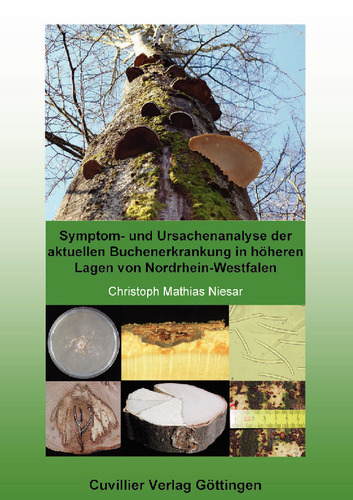
Symptom- und Ursachenanalyse der aktuellen Buchenerkrankung in höheren Lagen von Nordrhein-Westfalen (English shop)
Christoph Mathias Niesar (Author)Preview
Table of Contents, Datei (11 KB)
Extract, Datei (180 KB)
If nature were given completely free rein in a North Rhine-Westphalia devoid of people, forests shaped above all by the European beech and frequently dominated by it would develop over the course of the years. This attests to the high competitive strength of this tree species in relation to other trees. The extent to which this will shift as a result of climate change is currently under discussion. From the perspective of forest protection, beech is regarded as a stable tree species. Major damage is caused above all by beech bark necrosis. The last major wave of beech dieback occurred more than 40 years ago. In 1999, damage reminiscent of this disease occurred in beech stands exclusively at the higher elevations of North Rhine-Westphalia. In contrast to the situation in the years 1959 to 1966, however, the lowlands remained free of damage.
Also new in 1999 was the fact that the bark disease was almost exclusively confined to the northern flanks of the beech stems, accompanied by heavy infestation with wood-colonising ambrosia beetles of hardwood timber. This raised the following questions: do these processes constitute classical beech bark necrosis or a new, hitherto undescribed disease? Why does the disease occur only at the higher elevations of the low mountain ranges, and what are the essential biotic and abiotic causal factors? The investigations presented in this work were carried out as a contribution towards clarifying these questions. The focus is on the fungal flora in the early stages of bark necrosis, which has hitherto been little studied, as well as on the possible involvement of weather influences in the complex of causes. The findings obtained reveal a new picture of the significance of fungi within the complex of causes and a connection with the emerging climate change.
| ISBN-13 (Printausgabe) | 3867275327 |
| ISBN-13 (Hard Copy) | 9783867275323 |
| ISBN-13 (eBook) | 9783736925328 |
| Language | German |
| Page Number | 120 |
| Edition | 1 |
| Volume | 0 |
| Publication Place | Göttingen |
| Place of Dissertation | Göttingen |
| Publication Date | 2008-02-27 |
| General Categorization | Dissertation |
| Departments |
Forest science
|


