
Cuvillier Verlag GmbH



| Departments | |
|---|---|
| Book Series (99) |
1415
|
| Nachhaltigkeit |
3
|
| Gesundheitswesen |
3
|
| Humanities |
2411
|
| Natural Sciences |
5429
|
| Mathematics | 230 |
| Informatics | 320 |
| Physics | 982 |
| Chemistry | 1371 |
| Geosciences | 131 |
| Human medicine | 246 |
| Stomatology | 10 |
| Veterinary medicine | 112 |
| Pharmacy | 147 |
| Biology | 837 |
| Biochemistry, molecular biology, gene technology | 121 |
| Biophysics | 25 |
| Domestic and nutritional science | 45 |
| Agricultural science | 1005 |
| Forest science | 201 |
| Horticultural science | 20 |
| Environmental research, ecology and landscape conservation | 148 |
| Engineering |
1821
|
| Common |
97
|
|
Leitlinien Unfallchirurgie
5. Auflage bestellen |
|
Advanced Search
Modellierung und Simulation von Testautomaten für integrierte Schaltungen (English shop)
Harald Grams (Author)Preview
Table of Contents, Datei (90 KB)
Preface, Datei (82 KB)
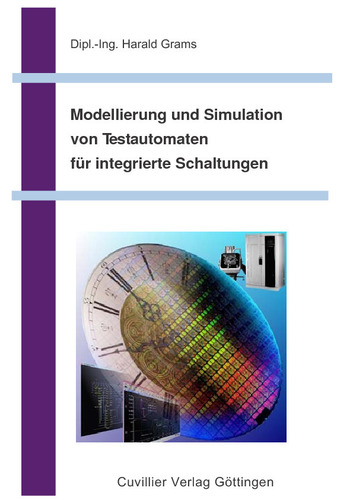
This work describes the modelling and simulation of automatic test equipment in order to simulate test programs and to evaluate new architectural concepts for test systems. To this end, the hardware and software components of currently available test systems are first analysed. The analysis shows that the evolutionary development of hardware towards ever more flexible systems leads to problems in the modelling and programming of the instruments. The examination of available virtual test products revealed that a general approach addressing the test engineer’s task as a whole is lacking. The virtual test environment created in this work offers the possibility of test program simulation at various levels of abstraction. A method for network-wide data exchange was developed which synchronises concurrent processes with cycle-accurate timing. Using the example of a digital pin, solutions are presented showing how complex instrument behaviour can be abstracted in order to arrive at fast simulation models. In order to come closer to the goal of writing test programs quickly and effectively [ITRS2003] with the aid of a system-independent high-level language, the de-refinement of the hardware is necessary from today’s perspective. For this purpose, a modelling concept for the development of a new test system architecture is presented, which verifies the interaction of various components within an architecture and compares different architectural concepts with one another.
| ISBN-13 (Printausgabe) | 3865372295 |
| ISBN-13 (Hard Copy) | 9783865372291 |
| ISBN-13 (eBook) | 9783736912298 |
| Language | German |
| Page Number | 140 |
| Edition | 1 Aufl. |
| Volume | 0 |
| Publication Place | Göttingen |
| Place of Dissertation | Erlangen-Nürnberg |
| Publication Date | 2004-09-20 |
| General Categorization | Dissertation |
| Departments |
Informatics
Mechanical and process engineering |


