
Cuvillier Verlag GmbH



| Departments | |
|---|---|
| Book Series (99) |
1415
|
| Nachhaltigkeit |
3
|
| Gesundheitswesen |
3
|
| Humanities |
2412
|
| Natural Sciences |
5430
|
| Engineering |
1821
|
| Engineering | 292 |
| Mechanical and process engineering | 872 |
| Electrical engineering | 700 |
| Mining and metallurgy | 30 |
| Architecture and civil engineering | 76 |
| Common |
97
|
|
Leitlinien Unfallchirurgie
5. Auflage bestellen |
|
Advanced Search
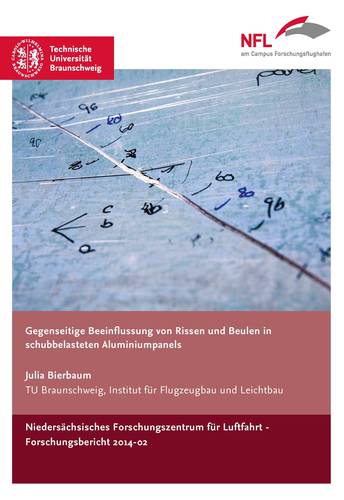
Gegenseitige Beeinflussung von Rissen und Beulen in schubbelasteten Aluminiumpanels (English shop)
Julia Bierbaum (Author)Preview
Extract, PDF (230 KB)
Table of Contents, PDF (56 KB)
Stability and damage tolerance behaviour is a key design criterion for aircraft structures. Both disciplines are the subject of numerous scientific studies, but they have generally been considered separately from one another. In this work, the mutual influence of shear buckling and cracks in aluminium structures is explicitly investigated by means of experiments, simulation (finite element method) and analytical models for calculating crack propagation. Various test configurations, crack positions and orientations confirm that the maximum principal stress, which arises along the diagonal of the panel as a result of shear buckling, is the decisive parameter influencing crack propagation. The increasing out-of-plane deformation caused by growing crack lengths leads to accelerated crack growth. Using the analytical models, it is shown that neglecting this effect results in an overestimation of the sustainable load cycles.
| ISBN-13 (Hard Copy) | 9783954046461 |
| ISBN-13 (eBook) | 9783736946460 |
| Final Book Format | A5 |
| Language | German |
| Page Number | 202 |
| Lamination of Cover | glossy |
| Edition | 1. Aufl. |
| Publication Place | Göttingen |
| Place of Dissertation | TU Braunschweig |
| Publication Date | 2014-03-11 |
| General Categorization | Dissertation |
| Departments |
Mechanical and process engineering
|
| Keywords | Cracks, buckles, shear loading, crack propagation, damage tolerance behaviour, stability behaviour, finite element analysis, aluminium structures, |


