
Cuvillier Verlag GmbH



| Departments | |
|---|---|
| Book Series (99) |
1415
|
| Nachhaltigkeit |
3
|
| Gesundheitswesen |
3
|
| Humanities |
2411
|
| Natural Sciences |
5429
|
| Mathematics | 230 |
| Informatics | 320 |
| Physics | 982 |
| Chemistry | 1371 |
| Geosciences | 131 |
| Human medicine | 246 |
| Stomatology | 10 |
| Veterinary medicine | 112 |
| Pharmacy | 147 |
| Biology | 837 |
| Biochemistry, molecular biology, gene technology | 121 |
| Biophysics | 25 |
| Domestic and nutritional science | 45 |
| Agricultural science | 1005 |
| Forest science | 201 |
| Horticultural science | 20 |
| Environmental research, ecology and landscape conservation | 148 |
| Engineering |
1821
|
| Common |
97
|
|
Leitlinien Unfallchirurgie
5. Auflage bestellen |
|
Advanced Search
Wege zu makromolekularen Nanotransportern aus Sternpolymeren mittels RAFT-Polymerisation (English shop)
Martin Mänz (Author)Preview
Table of Contents, Datei (37 KB)
Extract, Datei (57 KB)
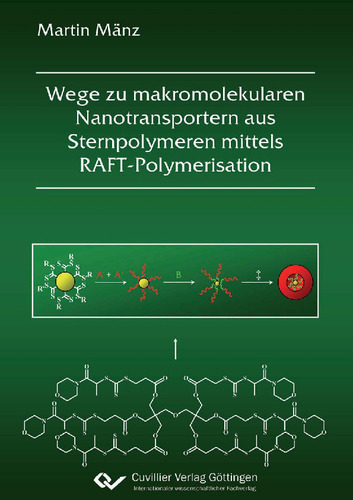
This work investigated the synthesis of nanotransporters from star block copolymers. The focus was on the synthetic options and their optimisation, with the aim of establishing a synthetic route to nanotransporters that is as precise as possible while remaining general. The transporters themselves were to consist of amphiphilic star block copolymers whose shell is cross-linked and whose core was to be removed subsequently in order to obtain hollow-sphere-like structures. To achieve this, numerous agents for reversible addition–fragmentation chain transfer (RAFT) polymerisation as well as monomers specifically suited for cross-linking were prepared. The polymerisations, copolymerisations and block copolymerisations of styrene and N-acryloylmorpholine (NAM) with various cross-linking monomers were likewise investigated.
Beginning with the RAFT agents, mono-, di-, tri-, tetra- and hexafunctional trithiocarbonates bearing leaving groups well suited for styrene or NAM polymerisations were synthesised. By means of the styrene polymerisations, the RAFT pre-equilibrium was examined with different leaving groups. This revealed rapid initiation of the main equilibrium in the case of leaving groups that provide sufficient stabilisation of the radical upon fragmentation. Depending on the rate at which the pre-equilibrium is passed through, multifunctional agents exert a strong influence on the topology of the resulting star polymer.
The homopolymerisation of the hydrophilic NAM was optimised with regard to amphiphilic block copolymerisations, and the behaviour of linear poly-NAM chains upon analysis on a lipophilic gel permeation chromatography system was investigated. Owing to the repulsive interactions with the stationary GPC phase, the poly-NAM appears smaller than it actually is. For linear chains, a molar-mass-independent shrinkage was found which can be corrected to the actual molar masses by multiplying the measured values by a factor of 3.8.
The copolymerisations with monomers bearing cross-linking functionalities were investigated. A susceptibility to premature linking of the polymer chains was observed at high cross-linking monomer concentrations. However, the transfer reactions feared for hydrogen-acidic functionalities were not observed. In block copolymerisations, dead polymer chains are formed and new homopolymer chains are started upon commencement of the polymerisation of the second block. When macrostar RAFT agents are used, this can lead to a certain degree of miktoarm star formation. By combining monofunctional and multifunctional RAFT agents, a simple calibration procedure was applied in order to determine the average molar masses of star polymers and star copolymers on a GPC system calibrated with linear polymer.
Various coupling reactions were examined for their applicability to cross-linking a nanotransporter shell. Schiff base formation proved unsuitable, as the aldehydes are too reactive towards the trithiocarbonates. Cross-linking by ester formation, in contrast, could be successfully tested on the polymer. Preliminary investigations using Huisgen 1,3-dipolar cycloadditions, acid imide formation and photosensitive [2+2] cycloadditions were likewise completed successfully.
Among the syntheses of modified monomers, a palladium-catalysed Sonogashira cross-coupling deserves particular mention, in which aryl bromides, otherwise very unreactive under Sonogashira conditions, were converted efficiently.
| ISBN-13 (Printausgabe) | 3869554274 |
| ISBN-13 (Hard Copy) | 9783869554273 |
| ISBN-13 (eBook) | 9783736934276 |
| Language | German |
| Page Number | 206 |
| Edition | 1 Aufl. |
| Volume | 0 |
| Publication Place | Göttingen |
| Place of Dissertation | Universität Göttingen |
| Publication Date | 2010-08-03 |
| General Categorization | Dissertation |
| Departments |
Chemistry
|


